
Behind the Lens on Leon Marchand: Beyond Gold Series
When most people think about Olympic swimming, they picture race day. The crowd. The atmosphere. The medals.
What they do not see are the thousands of hours that happen long before an athlete ever steps onto the blocks.
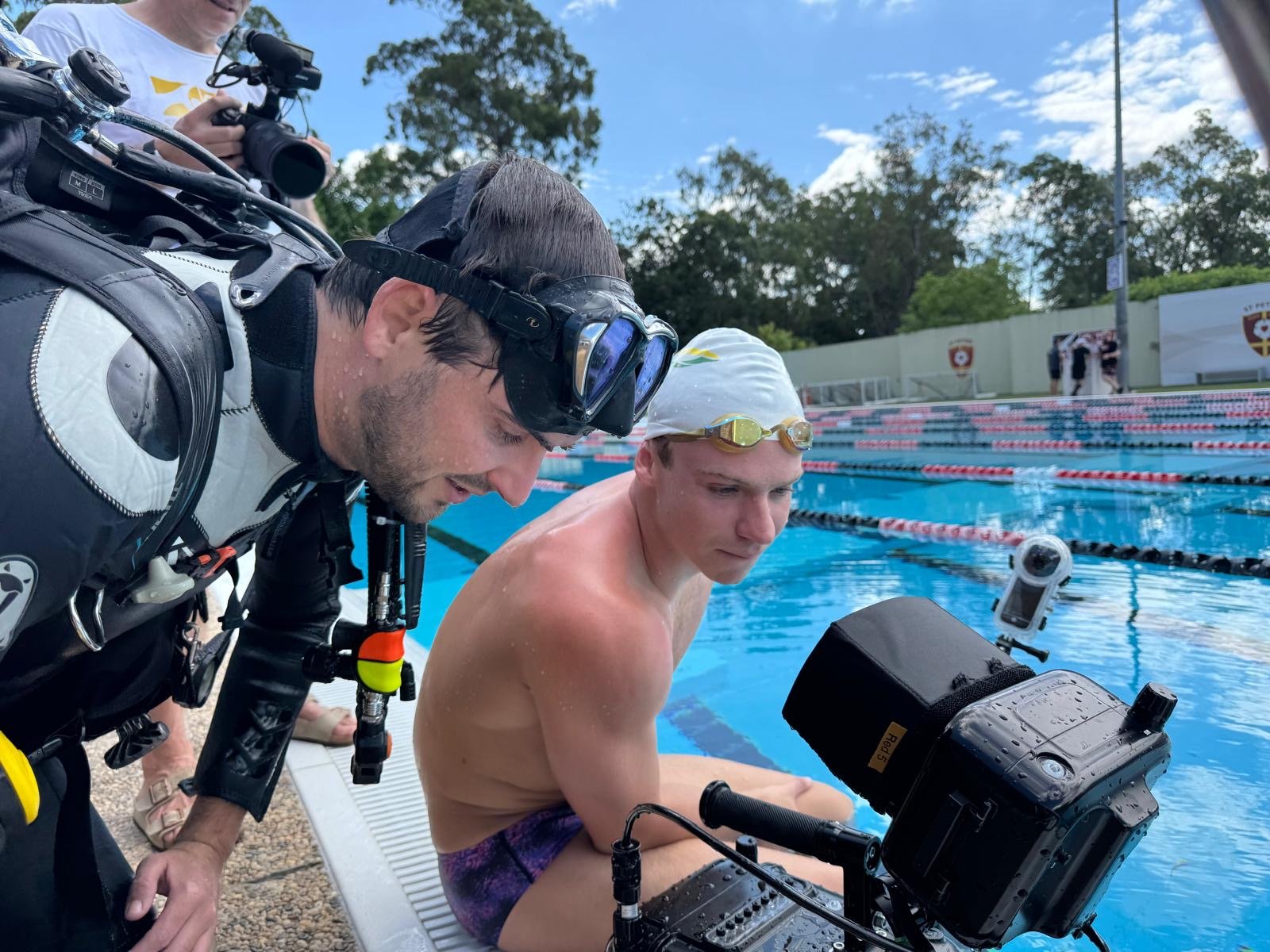
Earlier this year, I joined the production team behind Leon Marchand: Beyond Gold as an underwater cinematographer and topside camera operator, filming Leon's Australian training campaign in the lead up to the World Championships following his extraordinary multi gold medal success at the Paris Olympics.
Produced by Xavier Marchand and Qlad Labs France, and premiering on France.TV, the series follows Leon during a period where much of his life revolved around one thing: training.
As a filmmaker, that meant documenting not just the performances everyone knows him for, but the thousands of repetitions, early mornings, and long days that sit behind them.
Underwater Audio Production 101
Comms, Full Face Masks, and Sync Workflows in Broadcast Natural History
Underwater cinematography gets all the attention.
The light rays. The sharks. The whales. The big wide reef scenes.
But if you strip away clean audio, most of those sequences fall apart.
On major natural history productions like Deadly 60, All the Sharks, and most presenter led programs underwater audio isn’t an afterthought. It’s a fully engineered system. And it’s one of the most technically demanding parts of filming underwater.
Here’s how it actually works.
Full Face Masks: Not Just a Mic
For presenter-led sequences underwater, we don’t use a simple hydrophone and hope for the best.
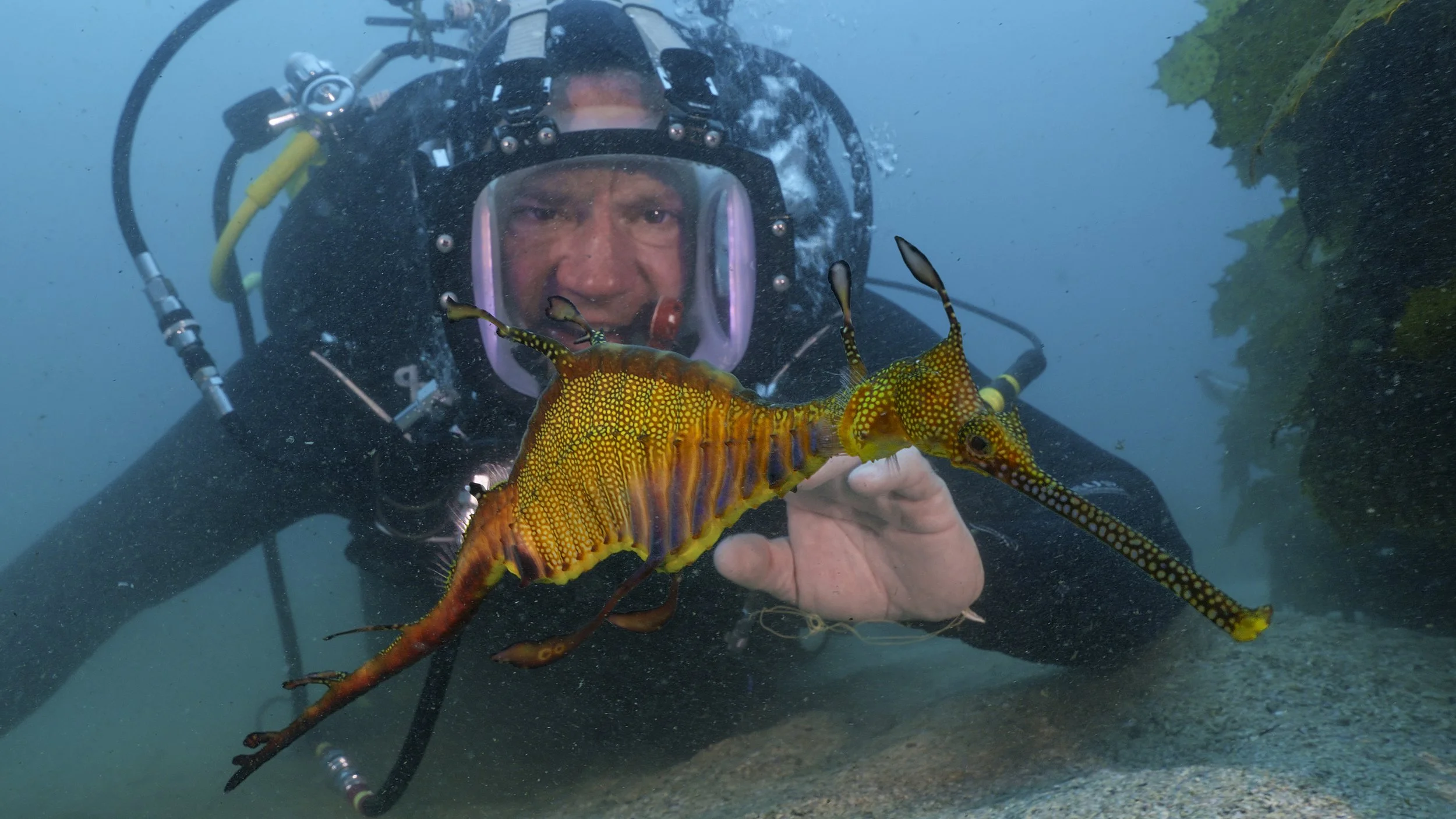
We use full face masks such as those produced by OTS (Ocean Technology Systems) or Ocean Reef. These are sealed dive masks with integrated microphones and comms systems built into the regulator assembly. They allow the presenter to breathe normally while delivering clean dialogue directly into a sealed mic environment.
Why this matters:
• No bubbles blasting across an open mic
• No regulator noise overpowering speech
• Stable mic placement relative to the mouth
• Continuous two-way communication with surface and with the dive teams and camera operator
The mask becomes part of the audio chain.
On a show built around reaction and presence, this is critical. When a shark changes direction or a coral spawning event suddenly happens, the reaction needs to be immediate. Authentic. Clean.
You don’t get second takes in wildlife.
Behind the Scenes of Netflix’s All the Sharks: An Insane Underwater Shoot!
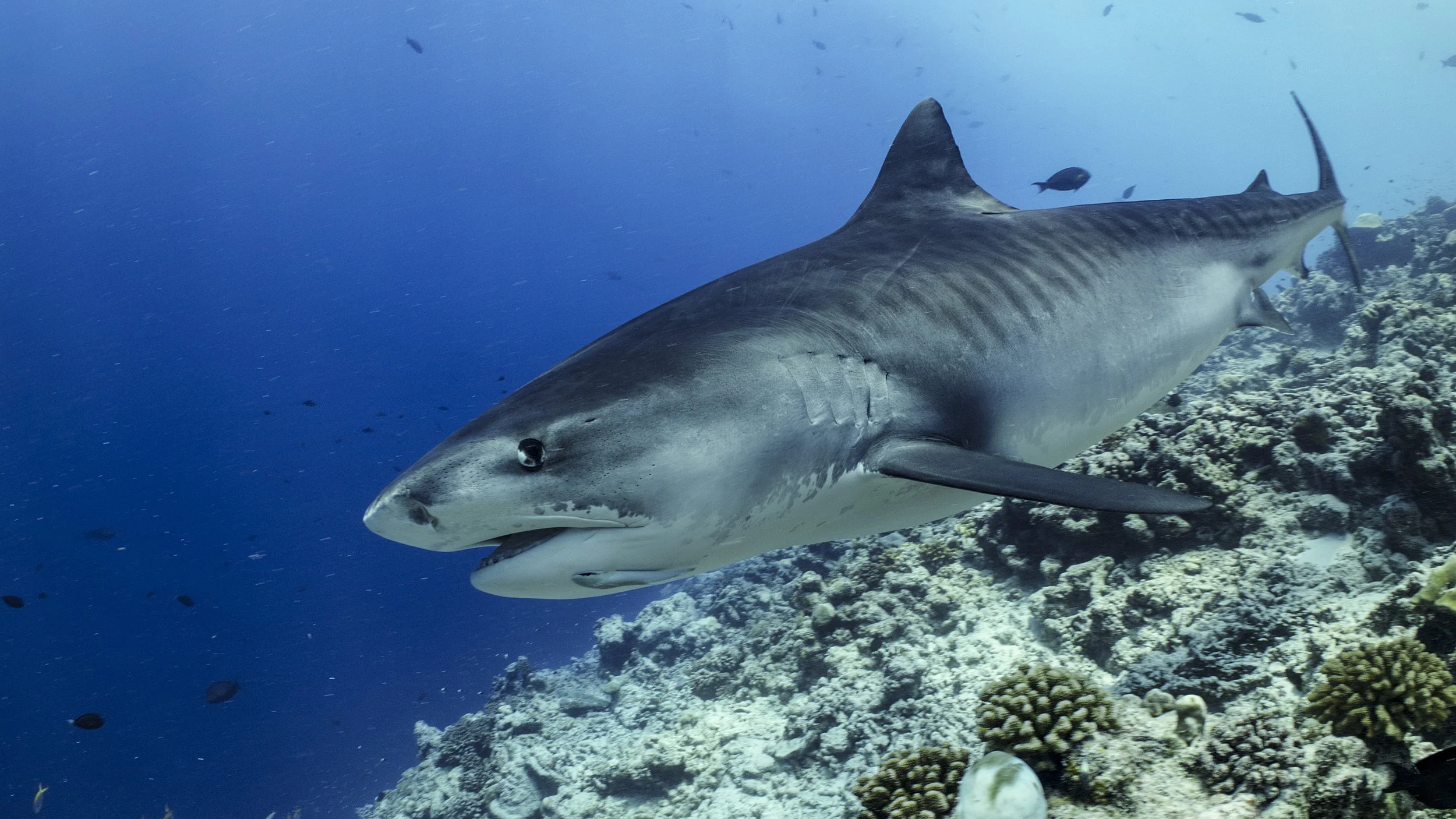
Working on Netflix’s All the Sharks was on a scale I’ve never experienced before. At times, there were over 50 crew on location and more than three tonnes of camera equipment. Every day felt like orchestrating a mobile underwater production unit capable of moving between multiple countries, ecosystems, and shark species, all while keeping the operation safe, seamless, and cinematic.
The Gear and Camera Set Up:
Underwater, we were shooting on an assortment of RED cameras: my 8K RED V-Raptor, two more V-Raptor VV models, a RED Gemini, RED Monstro, and RED Helium 8K, a total of 6 RED Underwater cinema systems. Each had a selection of Gates and Nauticam housings, domes, and lenses. The technical complexity alone was staggering, syncing camera frames, white balances, timecodes, and exposure across different cameras while maintaining the freedom to capture unpredictable shark behaviour.
Topside, the production used 4 Varicams, 4 Sony FX3s, a range of FX6s, 30+ GoPro’s rigged absolutely everywhere, and countless drones ensuring that aerials, presenter sequences, and surface interactions were fully covered.
Behind the Scenes Filming Deadly 60 with Steve Backshall
Working on Deadly 60 is a bit like jumping onto a rollercoaster in the middle of the first loop, it’s fast, chaotic, and completely exhilarating. I had the privilege of filming parts of Season 6 and the upcoming Season 7, both underwater and topside as the Director of Photography (DOP), and it’s an experience that pushes every aspect of your cinematography skills.
The Challenge of the Two Shot:
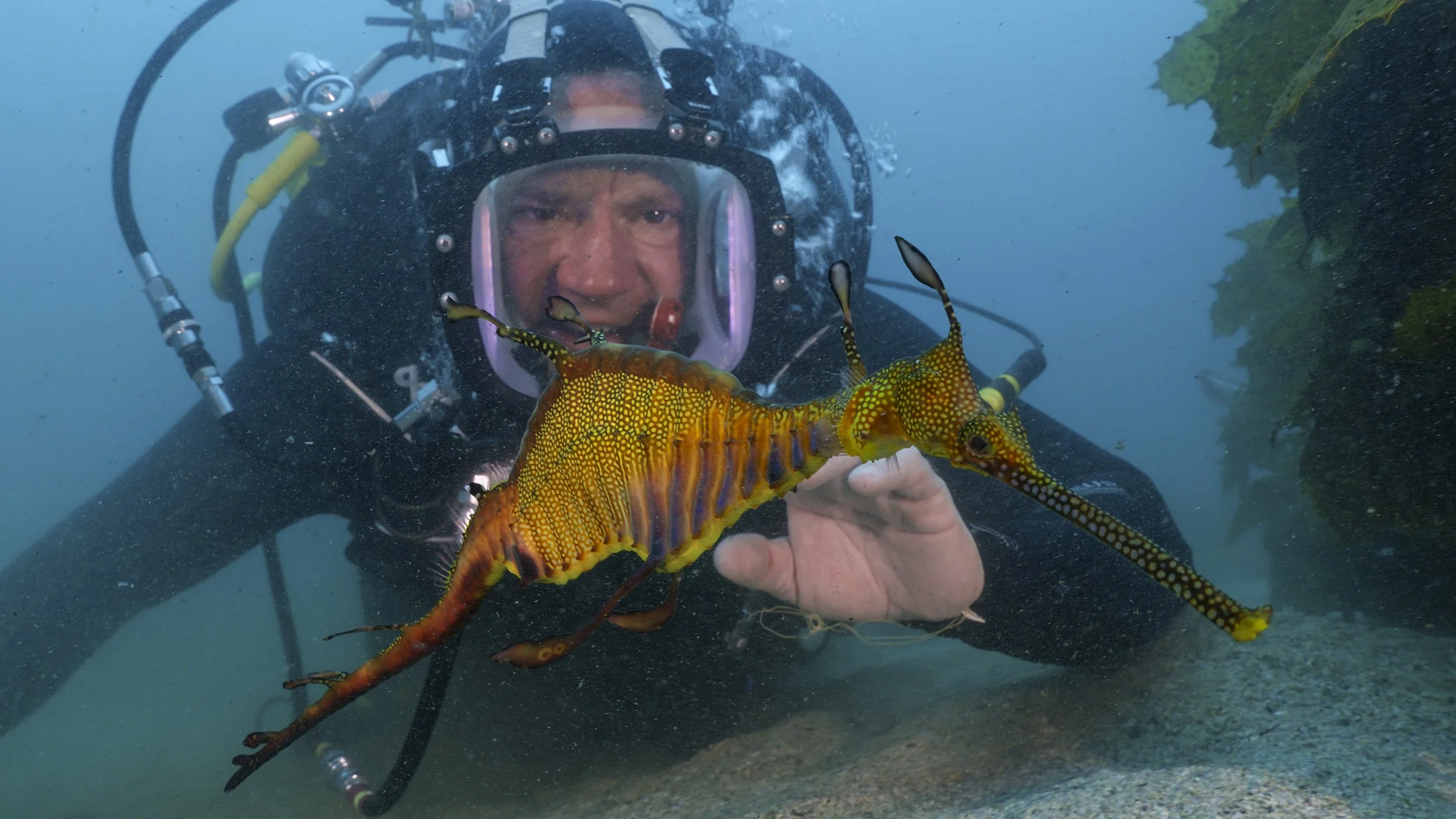
One of the toughest things we do is the “two-shot”, getting Steve and the animal in frame together, both above and underwater. For example, filming Weedy Sea Dragons in Sydney or Grey Nurse Sharks in Jervis Bay, the animal isn’t going to pause for the presenter. It’s about positioning Steve in a way that feels natural while keeping the composition cinematic, and anticipating how the animal will move so the shot works from start to finish, and there’s enough time for Steve to present,
Underwater, this is often a challenge. You have currents, visibility, and we’re operating in a world that as humans, we’re simply not meant for. This is where knowing how to read wildlife, and how to position yourself, with both you and the presenter working in split second tandom is an absolute necessity. Both myself and Steve have to read the wildlife, and postion ourselves in a manner that allows both Steve and the animal to stay in frame, often with no time to communicate underwater. This may sound simple, but there’s a lot of moving parts! But when it works (and with experienced presenters and operators, it often does), it’s cinematic magic.
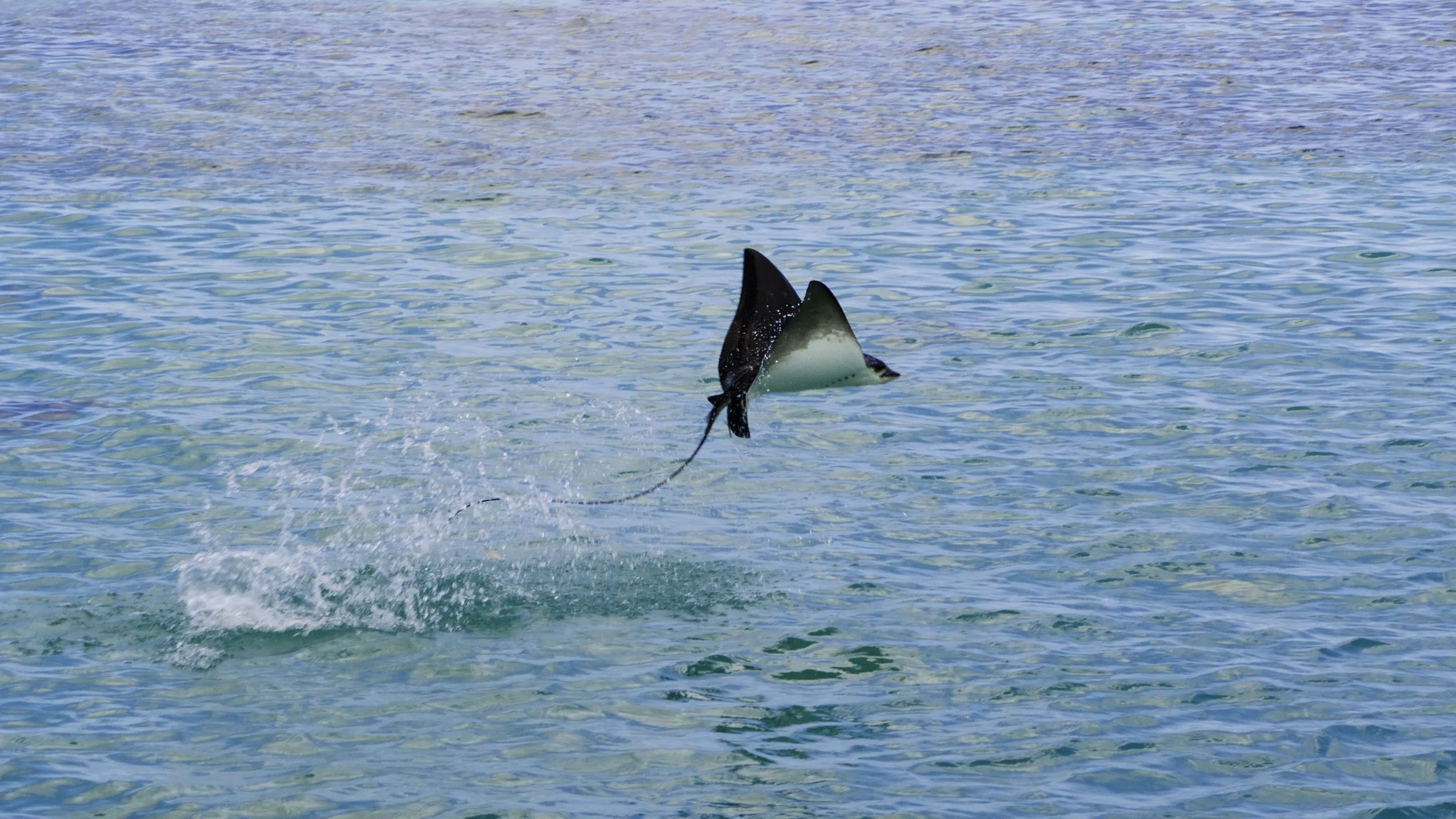
Filming Eagle Rays Breaching in 6K Ultra Slow Motion – Great Barrier Reef
The Filming Method: All sequences were filmed on the RED V-RAPTOR, locked off on a sturdy tripod with telephoto lenses.
Long lenses are essential. They compress distance, isolate the subject against the horizon, and allow space between camera and animal. At those focal lengths, even minor movement becomes exaggerated, so a solid tripod setup is critical.
Everything was shot in 6K at 180 frames per second.
At standard frame rates the breach feels abrupt. At 180fps ultra slow motion, you see the full wing extension, the body flex, the water displacement and the re-entry. It gives natural history productions the ability to study motion properly while retaining broadcast quality resolution.
Manual focus was also key. Autofocus will hunt at long focal lengths, especially over reflective water. Pre focusing on a set distance and making subtle manual adjustments based on surface activity keeps the frame clean and stable when the breach happens.
The RED’s pre record function made a real difference as well. With unpredictable behaviour like this, you often react a fraction late. Pre record buffers several seconds before you hit the trigger, which means you capture the full take off rather than just the tail end.
Those tools matter when the entire event lasts less than a second.
Time and Positioning
Like most wildlife behaviour, this isn’t luck.
It’s repetition and positioning. Long sessions scanning the surface. Reading current lines. Watching where rays are feeding. Adjusting framing constantly to anticipate direction rather than react to it.
You don’t chase breaches. You prepare for them.
When it lines up, it happens fast.
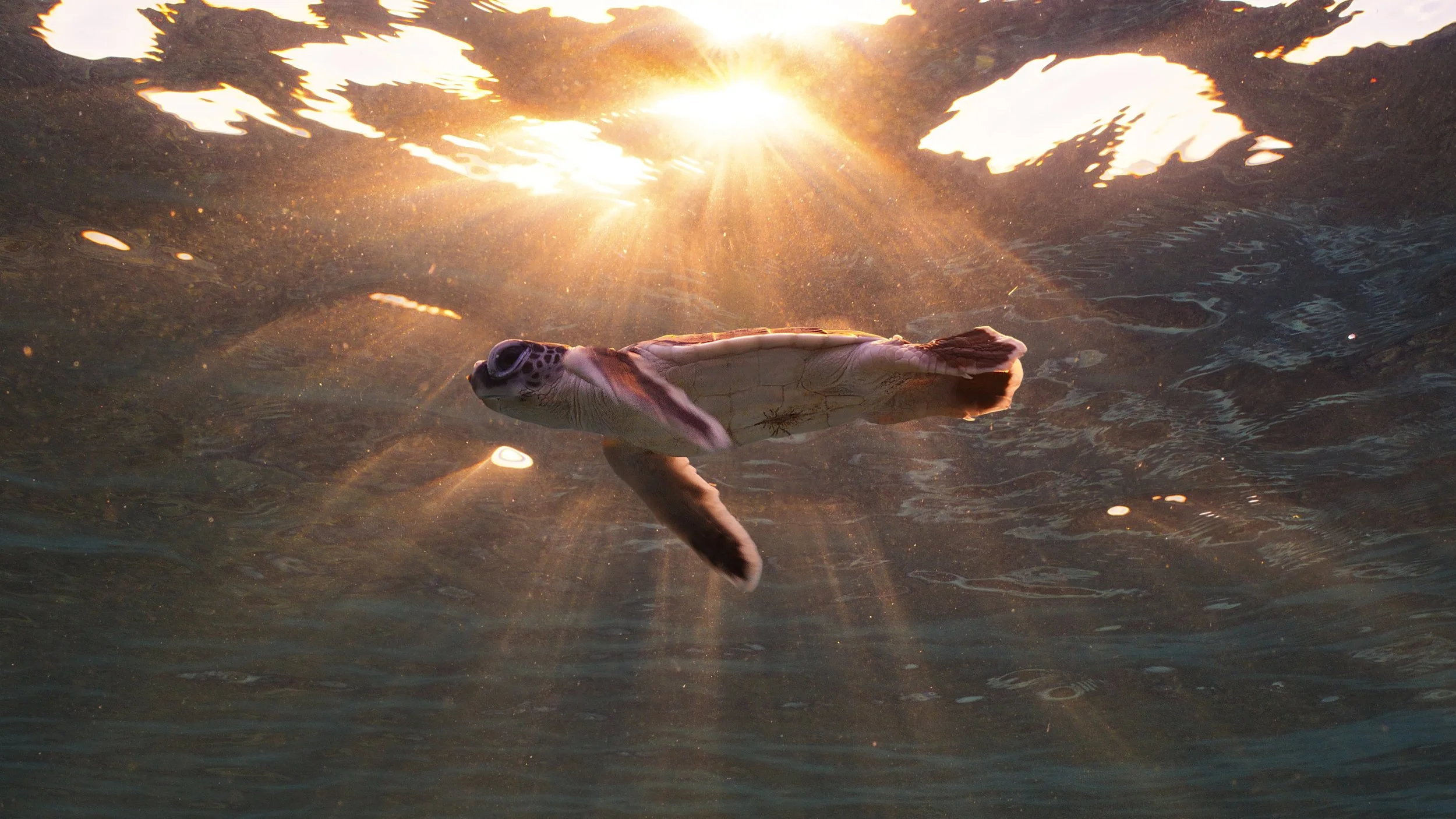
Filming Green Sea Turtle Hatchlings in Open Water – Great Barrier Reef in 8K
I’ve spent close to 400 days filming green sea turtle hatchlings on the Southern Great Barrier Reef.
It sounds excessive until you try to line everything up.
The nests erupt. The hatchlings reach the water. But if you want something more than a shoreline moment, you have to stay with them.
We swim with them for kilometres, tracking them off the reef flats and into deeper water, so we can film them where their real journey begins. In the open ocean.
That’s where the real magic starts.
Leaving the Reef Flats
The reef flats are chaotic. Surge, breaking waves, shallow sand movement, and constant predators. It’s raw and unpredictable.
But once a hatchling clears the reef edge and the bottom drops away, everything changes. The water turns deep blue. Light rays start cutting through the surface. The scale becomes obvious. A hatchling only a few centimetres long suspended over open water feels completely different to one scrambling through the shallow reef flats.
To film that moment consistently takes repetition.
Tide has to be right so they push straight out instead of sideways (and so we can get our 20-30kg camera’s into the water and swim with them!). Conditions need to be calm enough for visibility. The sun needs to be low enough for clean shafts of light to break the water. And the hatchlings have to keep swimming, and not become prey.
Most of the time, one of those elements doesn’t line up.
That’s why it takes years.
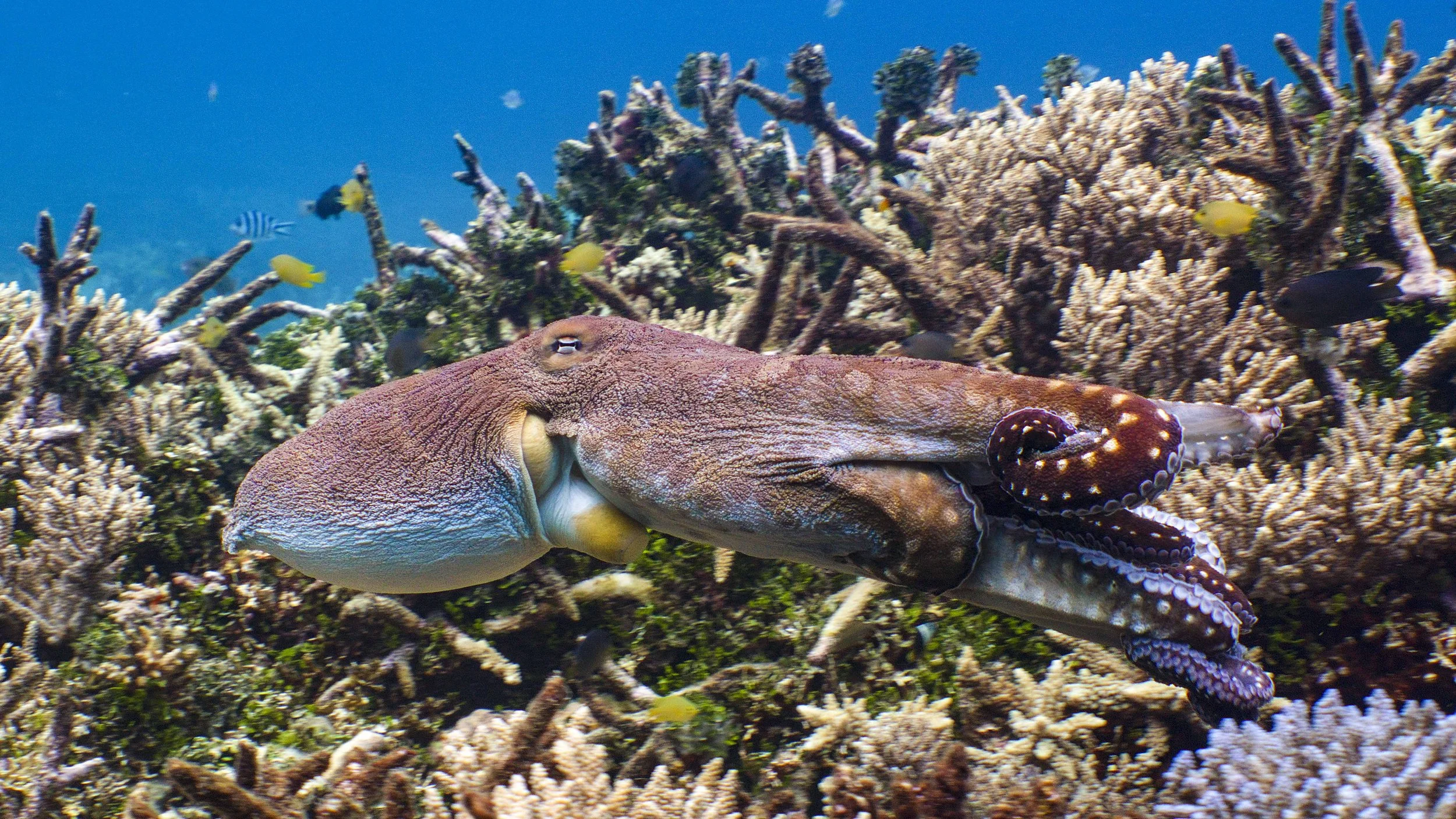
Filming a Hunting Day Octopus on the Great Barrier Reef in 8K
There’s nothing predictable about filming a day octopus.
Some bolt the second they feel pressure in the water. Others hold their ground, watching you just as closely as you’re watching them. This particular shoot on the Southern Great Barrier Reef came after a few days of doing very little filming at all and a lot of observing.
I’d found an individual working a section of reef near Heron Island. Rather than rush it, I spent time learning its routine. Where it sheltered. How far it ranged. When it chose to move. When it chose to hunt.
That patience is what led to this 8K octopus hunting stock footage sequence.
Understanding Octopus Behaviour Before You Hit Record
Day octopus are serious predators. When they hunt, there’s intent behind every movement.
They move across coral bommies using their arms almost like legs, then suddenly jet across open sand when they feel exposed. As they transition between coral, rubble, and sand, their skin shifts constantly. Colour, contrast, texture. It’s not dramatic for the sake of it. It’s camouflage working in real time.
In this sequence, you can see the octopus probing into crevices, feeling for crabs and small reef fish. It pauses, recalibrates, then moves again. Every decision is calculated.
To capture that kind of natural behaviour on the Great Barrier Reef, you need more than just a good camera. You need time in the water.

Filming Ocean with David Attenborough
Earlier this year, I had the incredible opportunity to work on and contribute to Ocean with David Attenborough. As an underwater cinematographer, it was a huge honour to be a part of the film. Sir David Attenborough has inspired generations of wildlife filmmakers, and to get the call to contribute to one of his films is the highlight of my professional career. A true career milestone.
My work for Ocean focused on the Great Barrier Reef, specifically around the 2024 global mass coral bleaching event. At the time the bleaching hit, I had already spent nearly 300 days filming this one particular section of reef for another natural history film I have been working on, a vibrant, bustling ecosystem. Almost overnight, I watched this incredible ecosystem transform into a stark, white landscape. It was devastating.