
Behind the Scenes Filming Deadly 60 with Steve Backshall
Working on Deadly 60 is a bit like jumping onto a rollercoaster in the middle of the first loop, it’s fast, chaotic, and completely exhilarating. I had the privilege of filming parts of Season 6 and the upcoming Season 7, both underwater and topside as the Director of Photography (DOP), and it’s an experience that pushes every aspect of your cinematography skills.
The Challenge of the Two-Shot
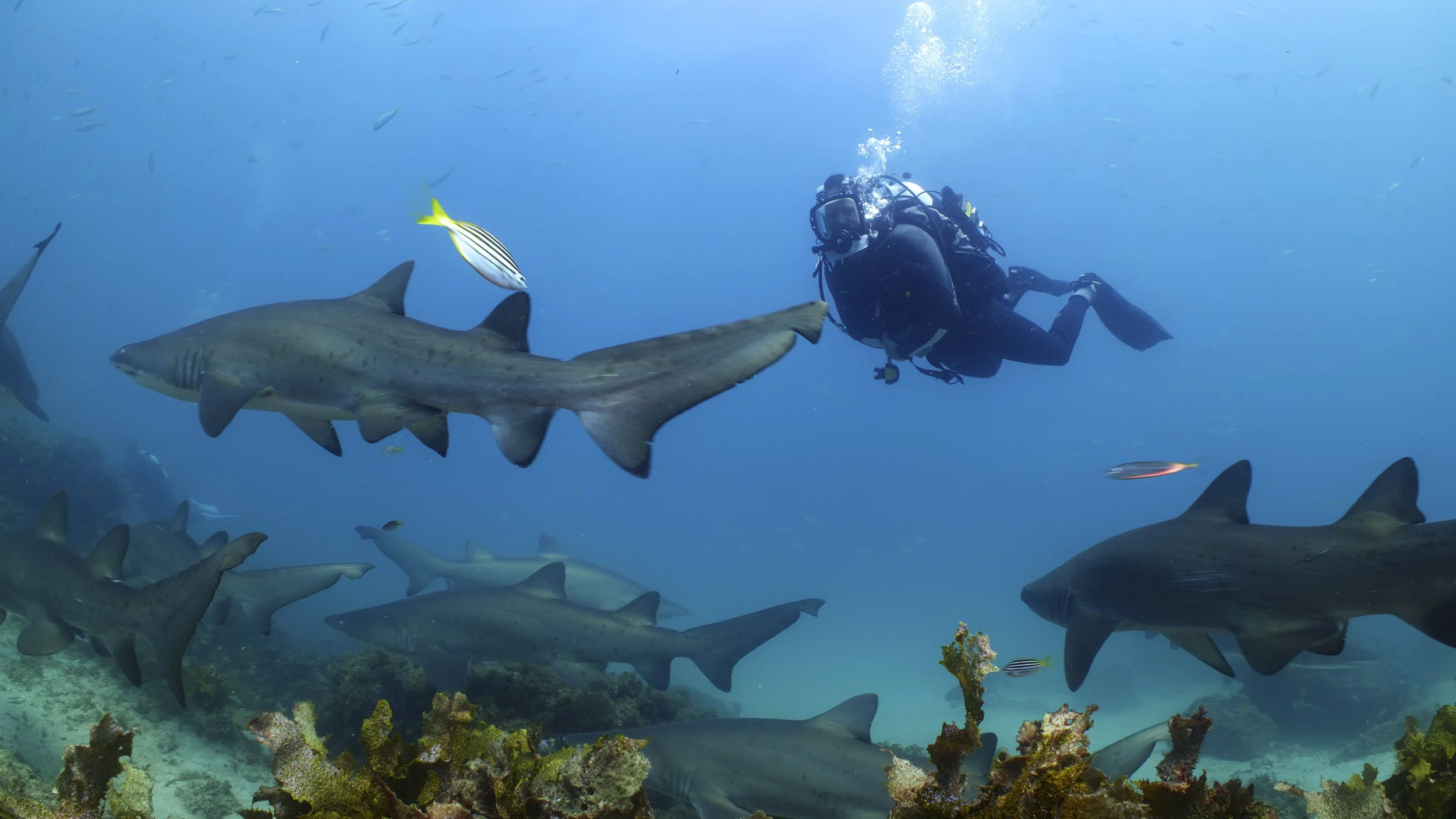
One of the toughest things we do is the “two-shot”, getting Steve and the animal in frame together, both above and underwater. For example, filming Weedy Sea Dragons in Sydney or Grey Nurse Sharks in Jervis Bay, the animal isn’t going to pause for the presenter. It’s about positioning Steve in a way that feels natural while keeping the composition cinematic, and anticipating how the animal will move so the shot works from start to finish, and there’s enough time for Steve to present,
Underwater, this is often a challenge. You have currents, visibility, and we’re operating in a world that as humans, we’re simply not meant for. This is where knowing how to read wildlife, and how to position yourself, with both you and the presenter working in split second tandom is an absolute necessity. Both myself and Steve have to read the wildlife, and postion ourselves in a manner that allows both Steve and the animal to stay in frame, often with no time to communicate underwater. This may sound simple, but there’s a lot of moving parts! But when it works (and with experienced presenters and operators, it often does), it’s cinematic magic.

Audio: The Unsung Hero
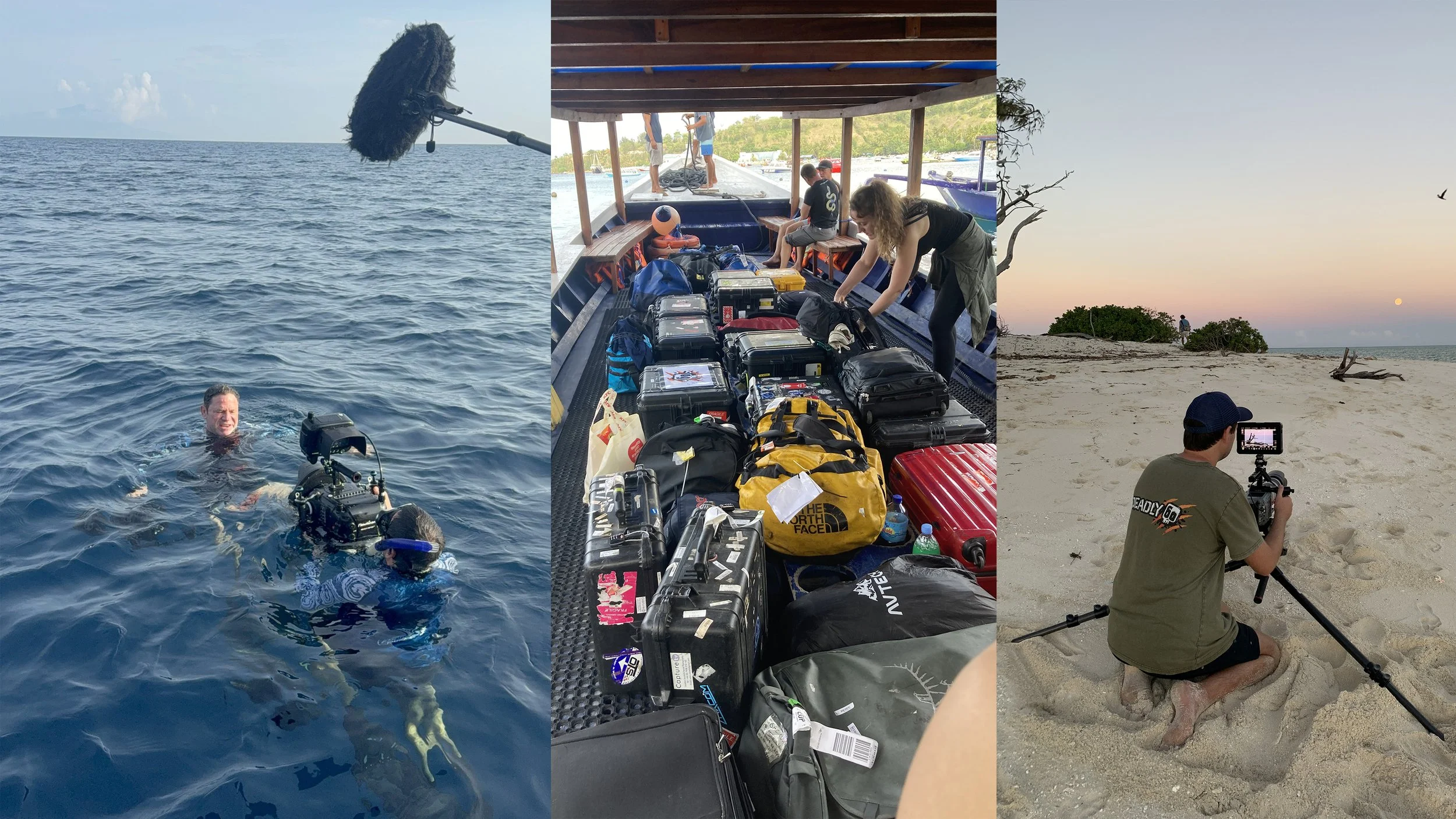
Capturing audio underwater on Deadly 60 is just as critical as the images. We don’t just use a microphone, we’re working with full face masks rigged with Sound Devices underwater units. Steve speaks naturally into the mask, which lets him react in real time to the animals allowing our soundy's to record crystal clear dialogue - even while underwater. This dialogue is even relayed to the boat above allowing the soundy to monitor the recording, and giving the producers topside an idea of how the dive underwater is going in real time.
All of this is synced to the RED V-Raptor 8K I’m operating using timecode boxes, so every line, every reaction, is perfectly aligned in post. On a show like Deadly 60, timing and reaction are everything. Steve’s commentary often happens in direct response to what the animal is doing, so if the audio isn’t clean or in sync, the moment is lost. Audio on a show like this, is often far more critical than even the visuals! The soundy doesn’t have the luxury of being able to cut to B-roll!
This audio system allows us to capture authentic underwater presentation in challenging environments while keeping all production elements perfectly coordinated. It’s one of the behind-the-scenes pieces that makes the two-shot, and the series in general, feel alive and immersive. Chaotic, Fast-Paced, Unpredictable.
Deadly 60 is always moving. One minute we’re on a muck dive in Indonesia looking for rare Ghost Pipefish; the next, we’re on a coral reef hunting an elusive predator or setting up for a topside encounter with a King Cobra or Viper. The crew is constantly packing, unpacking and rigging up camera systems, and repositioning. Every location is a race against time and tide, and the weather doesn’t always play ball.
That unpredictability pushes you creatively, keeps shots fresh, and means every day is different.
Up Close With Deadly Wildlife
On camera, Steve’s fearless and intuitive, able to handle situations most people would never even consider. I’ve called him a madman many times, but it’s his ability to read wildlife, and stay calm with even the most deadly of species, that allows him to get so close and pull of sequences that many wouldn’t dare. As wild as Steve Backshall is on camera, it’s often a lot of the off camera work done by the crew, producers and Steve himself that enables him to safely jump into these truly wild situations. The prep work here to ensure these scenes are able to be filmed safely is huge.
Season 6 Highlights: Sydney and Jervis Bay
In Season 6, I filmed underwater in Sydney, capturing Weedy Sea Dragons ambush hunting against soft kelp backdrops, and Grey Nurse Sharks and Wobbegongs for the BAFTA Nominated shark special in Jervis Bay. These shoots required long dives, careful light management, and constant awareness of animal behaviour. While shooting in Sydney, our crew came face to face with 2–3 metre visibility, a real challenge when trying to capture delicate interactions like a Weedy Sea Dragon hunting in its natural environment. It not only makes it much harder to find these animals, but forces us to get much closer to film the two shot underwater to keep the shot clean and as free as possible from backscatter.
This isn’t purely an underwater operation. Behind all these grand shots, and epic ep, there’s an entire production machine running in the background to ensure we have the best chance of capturing these stories and making them seem effortless, but there’s only so much that can be done when the ocean gives you 2 meters of visiblity to work with! Regardless, as Steve said on his recent tour, the Weedy Sea Dragon sequence we captured that day, in shocking conditions, is one of his all time favourites.
While filming our Grey Nurse Shark story for BBC’s BAFTA Nominated Deadly 60 Shark Special, a series of East Coast lows had brought chaotic weather down the coast, forcing last-minute location changes and reschedules. We moved filming location a handful of times in only a few days, and in some cases, year-round populations of the species we were targeting had completely vanished as a result of the storm, and were found to have travelled over 800km from their usual sites in just a week. That meant scrambling to find protected dive and film sites, coordinating operators, and tracking animals who had shifted unexpectedly.
This sort of production chaos is par for the course in natural history filmmaking, and I have to give a huge shout out to the BBC and Steve’s team. I haven’t worked with many who can seamlessly pull off a complete production overhaul just days before a major shoot. Their efficiency and adaptability are why a series like Deadly 60 looks so effortless on screen, even when the reality behind the camera is anything but.
Season 7: Indonesia and Beyond
Season 7 took us to Indonesia for an extensive three-week shoot. Underwater, we tackled coral reefs, muck dives, and a variety of elusive species. Topsides, we filmed snakes, vipers, and King Cobras, using a variety of different rigs for the RED V-Raptor 8K, and a range of Sony FX6 and FX3 cameras for low light scenarios.
And then there was the Blue Whale.
Swimming with the Largest Animal on Earth
One of the most incredible wildlife encounters of my career involved five days of tracking and swimming with a Blue Whale. Getting the two-shot with Steve presenting alongside the largest animal on the planet required precise timing, buoyancy control, and coordination with the crew. These whales may look slow, but with the smallest movement of their gargantuan tail, they vanish into the distance. We were forced to move fast! Steve had to be in position, the whale had to be at the right distance, and the camera had to capture both clearly in frame. For this sequence we were lucky enough to have enough available light to shoot in ultra slow motion 120 frames per second full 8K, and to be able to shoot without artificial lights that would have slowed us down. The result: Steve next to a creature that dwarfs anything else on the planet, an absolutely surreal moment captured for the series.
Gear and Cinematography
Across all shoots, the RED V-RAPTOR 8K was our workhorse, both underwater and topside. Topside, long lenses and stabilised rigs allowed for us to use compression techniques to enhance detail in our two shots, and should rigs were used to keep the audience in the action, and feel the chaotic adventure vibe we were chasing. Manual focus, pre-record buffers, and careful lighting were critical for capturing high-speed, unpredictable wildlife behaviour. Underwater, freediving provided mobility without bubbles or disturbance, and scuba diving granted us the time underwater allowing Steve to present.
Every shot is about precision, anticipation, and execution. That’s what makes Deadly 60 both challenging and exhilarating.
The Takeaway
Filming Deadly 60 is chaotic, fast-paced, and utterly rewarding. It’s a masterclass of in the field cinematography, requiring skill and creativity across underwater and terrestrial environments. Being part of the crew, capturing these moments for a global audience, and working with Steve Backshall is an unreal experience, and it’s the kind of work that continues to shape me as a cinematographer every day.
Bio- Australian Underwater Cinematographer Tom Park
Tom Park is an accomplished underwater cinematographer and director from Australia, with over a decade of experience working in the underwater film industry. Tom has worked across major feature documentaries and natural history films including Blue Planet III, and for clients including BBC, Netflix, Amazon, Silverback Films, ARTE and David Attenborough. His films have been recognised with awards from film festivals around the world, including the prestigious Wildscreen Festival.
Tom is known for his technical expertise in working with underwater cameras and equipment, as well as his creative vision in capturing the beauty and uniqueness of the underwater world. He is passionate about ocean conservation and using his art to raise awareness about the importance of protecting marine ecosystems.