
Filming a Hunting Day Octopus on the Great Barrier Reef in 8K
There’s nothing predictable about filming a day octopus.
Some bolt the second they feel pressure in the water. Others hold their ground, watching you just as closely as you’re watching them. This particular shoot on the Southern Great Barrier Reef came after a few days of doing very little filming at all and a lot of observing.
I’d found an individual working a section of reef near Heron Island. Rather than rush it, I spent time learning its routine. Where it sheltered. How far it ranged. When it chose to move. When it chose to hunt.
That patience is what led to this 8K octopus hunting stock footage sequence.
Understanding Octopus Behaviour Before You Hit Record
Day octopus are serious predators. When they hunt, there’s intent behind every movement.
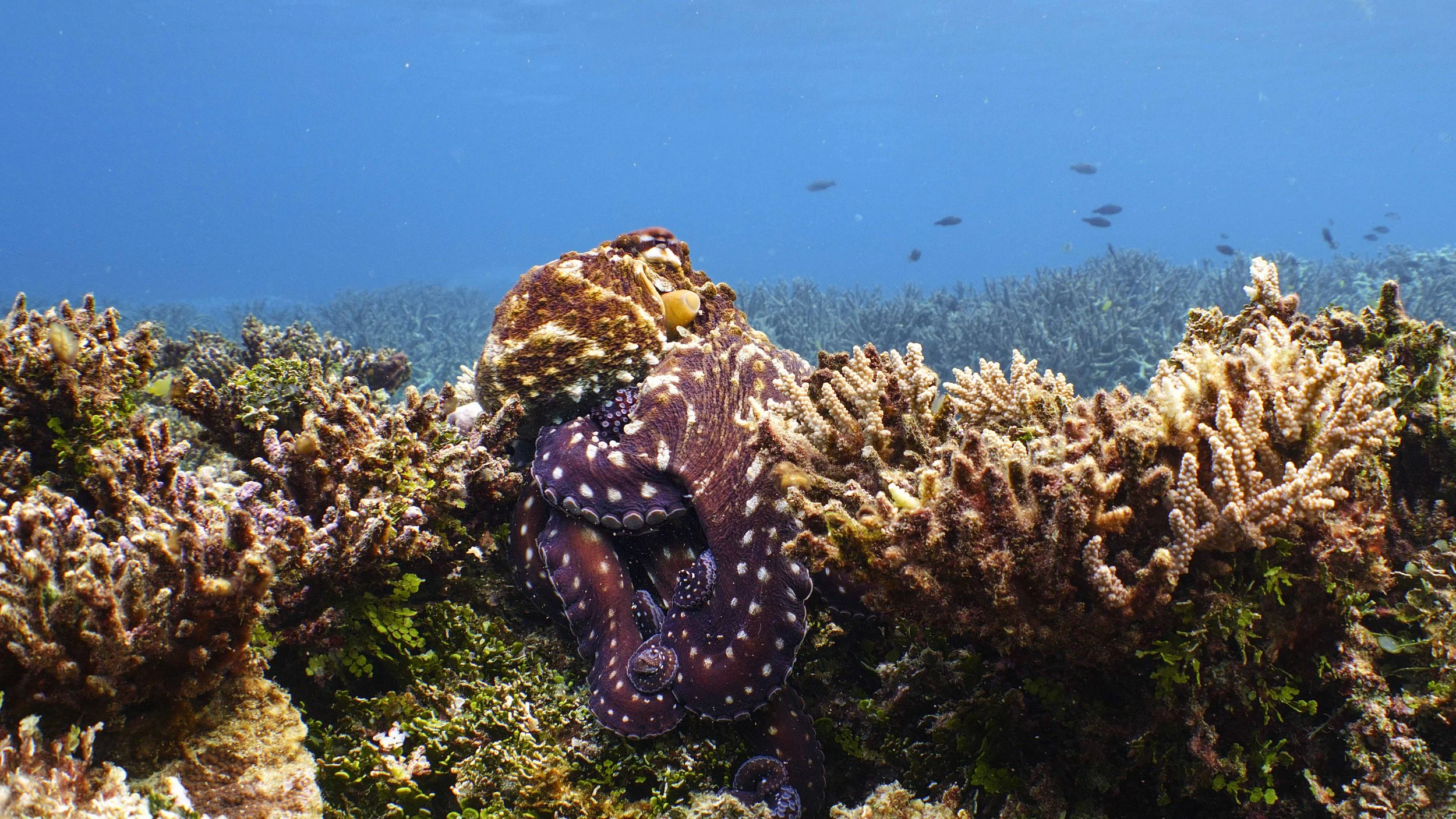
They move across coral bommies using their arms almost like legs, then suddenly jet across open sand when they feel exposed. As they transition between coral, rubble, and sand, their skin shifts constantly. Colour, contrast, texture. It’s not dramatic for the sake of it. It’s camouflage working in real time.
In this sequence, you can see the octopus probing into crevices, feeling for crabs and small reef fish. It pauses, recalibrates, then moves again. Every decision is calculated.
To capture that kind of natural behaviour on the Great Barrier Reef, you need more than just a good camera. You need time in the water.
Why I Shot This Freediving
I filmed this entirely while freediving. No bubbles. No regulator noise. No exhaust trail drifting across the reef.
On reefs like the Southern Great Barrier Reef, especially when filming sensitive species like octopus, scuba can change behaviour. Freediving allows for a quieter presence. I could approach slowly, surface, reset, and drop back down without constantly altering the soundscape.
Most of the work happened before the footage you see. Multiple entries. Holding distance. Letting the animal settle. Gradually closing that gap over several sessions.
When you see sustained octopus hunting behaviour on camera, that’s usually the result of hours or days of building tolerance.
Shot on RED V-RAPTOR 8K
This sequence was captured on the RED V-RAPTOR in 8K R3D RAW. Shooting 8K underwater isn’t about hype. It’s about detail and flexibility.
Octopus skin is incredibly complex. The texture shifts alone are worth capturing at the highest resolution possible. In 8K, you retain fine detail in both the animal and the surrounding coral reef structure.
For natural history productions, whether for Netflix, BBC, or high end documentary work, that resolution gives producers flexibility in post without compromising quality.
It also means this footage is future proof for premium broadcast.
8K Great Barrier Reef Octopus Stock Footage Available
The full hunting sequence is available as 8K stock footage.
It includes extended behaviour of a day octopus actively foraging across coral reef habitat, running and swimming between bommies and sand patches, dynamic colour changes, and natural predatory movement in clear tropical water on the Southern Great Barrier Reef.
If you’re producing a natural history series, wildlife documentary, conservation film, or need high end Great Barrier Reef octopus footage, the reel is available for licensing.
I also hold a wider archive of 8K underwater stock footage from the Great Barrier Reef and other Australian marine environments, including reef sharks, sea turtles, coral reef ecosystems, and behavioural wildlife sequences all available on my website.
Blog By Australian Underwater Cinematographer Tom Park
Tom Park is an accomplished underwater cinematographer and director from Australia, with over a decade of experience working in the underwater film industry. Tom has worked across major feature documentaries and natural history films including Blue Planet III, and for clients including BBC, Netflix, Amazon, Silverback Films, ARTE and David Attenborough. His films have been recognised with awards from film festivals around the world, including the prestigious Wildscreen Festival.
Tom is known for his technical expertise in working with underwater cameras and equipment, as well as his creative vision in capturing the beauty and uniqueness of the underwater world. He is passionate about ocean conservation and using his art to raise awareness about the importance of protecting marine ecosystems.