
Behind the Scenes of Netflix’s All the Sharks: An Insane Underwater Shoot!
Working on Netflix’s All the Sharks was on a scale I’ve never experienced before. At times, there were over 50 crew on location and more than three tonnes of camera equipment. Every day felt like orchestrating a mobile underwater production unit capable of moving between multiple countries, ecosystems, and shark species, all while keeping the operation safe, seamless, and cinematic.
The Gear and Camera Setup
Underwater, we were shooting on an assortment of RED cameras: my 8K RED V-Raptor, two more V-Raptor VV models, a RED Gemini, RED Monstro, and RED Helium 8K, a total of 6 RED Underwater cinema systems. Each had a selection of Gates and Nauticam housings, domes, and lenses. The technical complexity alone was staggering, syncing camera frames, white balances, timecodes, and exposure across different cameras while maintaining the freedom to capture unpredictable shark behaviour.
Topside, the production used 4 Varicams, 4 Sony FX3s, a range of FX6s, 30+ GoPro’s rigged absolutely everywhere, and countless drones ensuring that aerials, presenter sequences, and surface interactions were fully covered.

Crew, Safety, and Audio
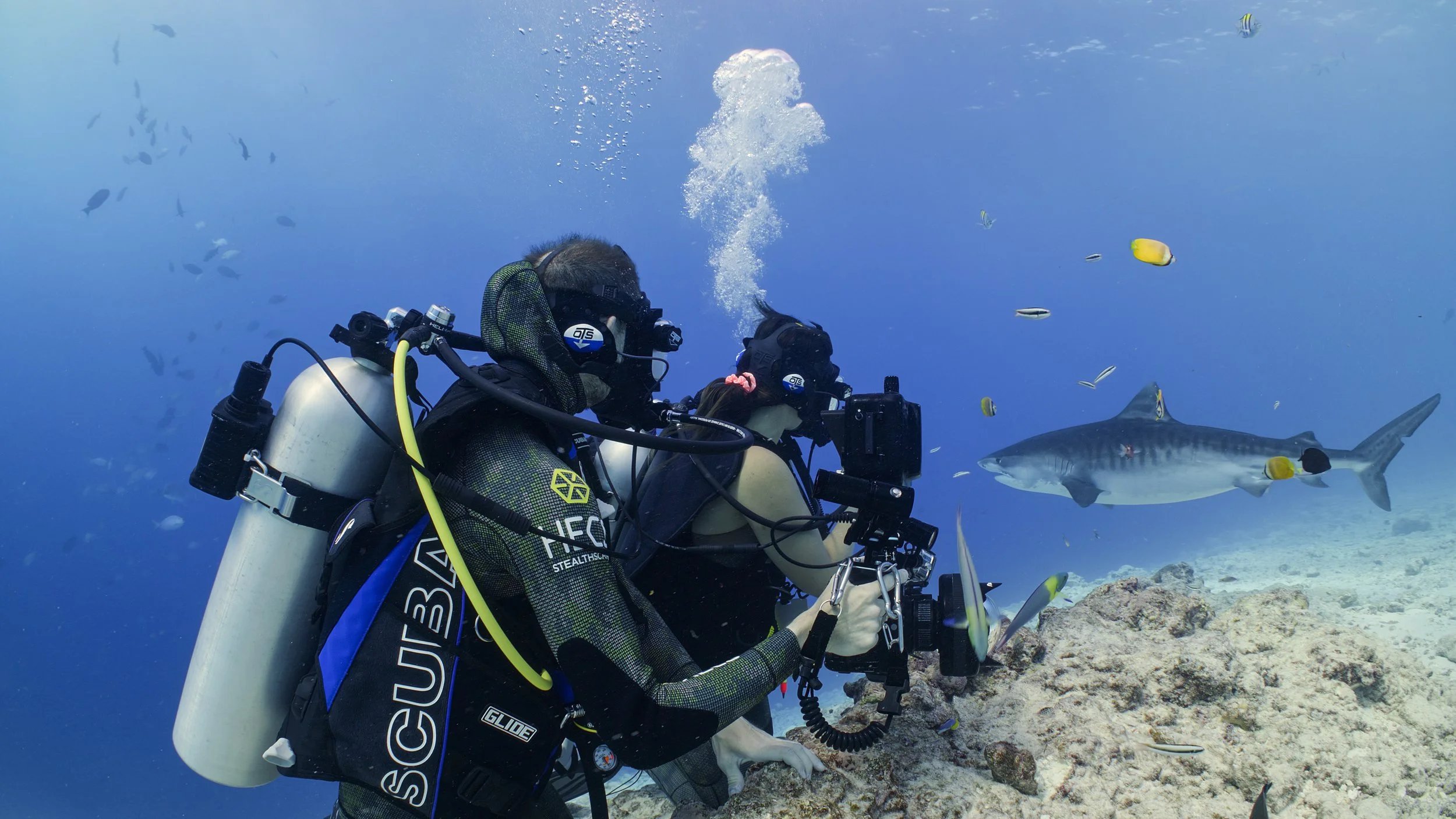
Sound recording was a full-scale operation. Four dedicated teams handled underwater audio with 8x OTS full-face masks, capturing presenter commentary, reactions, and ambient marine sound. Given we were diving with sharks, each underwater team had a field medic with experience in either SAS, SWAT, secret service, or combat medicine. Safety was paramount, but the scale and coordination of the teams made even the most chaotic situations manageable.
The Challenges of Scale
Throughout production we filmed across six different countries, diving with a huge variety of shark species from Reef Sharks, Epaulette Sharks and Wobbegongs on Heron Island on The Great Barrier Reef, to Tiger Sharks with one of the wildest vertical ascents in Fuvahmulah in the Maldives, Lemon Sharks and Great Hammerheads in Bimini, the Bahamas, Great Whites in South Africa, and Hammerheads and Bamboo Sharks in Japan, and even searching for Whale Sharks in the Galápagos Islands. Each location had its own challenges: brutal currents, jellyfish stings, visibility changes, and tides that forced constant adjustments to our dive plans and camera setups.
Despite all the chaos, there was a rhythm to the madness. The crew moved seamlessly from one environment to another, capturing rare and sometimes unbelievable moments that felt almost impossible in real time. From incredible schools of Hammerhead Sharks to daunting open-ocean searches for elusive Tiger Sharks and chance encounters with massive Whale Sharks, every shoot pushed us technically and creatively.
The Golden Shot: The Two-Shot
Every dive, every encounter, we’re targeting the “golden shot”: a perfectly framed two-shot of the shark in its natural environment with the presenter in the same frame. This is the ultimate challenge. Sharks don’t pause or follow directions, they move fast, unpredictably, and often at different depths than the presenter. To capture the moment, you need precise positioning, timing, and lens choice. It’s all about patience, anticipation, and capturing the interaction naturally while maintaining cinematic composition. It really requires an understanding of shark behaviour, such that you’re able to predict it’s movements and position yourself close enough to the shark to get that epic two shot of talent and shark together. When it works, you have a sequence that tells the story, conveys scale, and immerses the audience in the underwater world. In presenter led series there’s really nothing that compares to a two-shot!
Expertise and Execution
What made it work was the combination of experience and trust. I’ve spent years mastering underwater cinematography with high-end RED systems, have logged close to 4000 scuba dives, learned freediving techniques, and have thousands of hours using advanced filming rigs underwater. On a project of this magnitude, knowing your gear, anticipating wildlife behaviour, and coordinating with a large crew is non-negotiable.
Every sequence, from intimate reef interactions to epic open ocean shark passes relied on technical precision and creative foresight. And when everything came together, the results were cinematic, immersive, and unforgettable.
The Takeaway
Netflix’s All the Sharks was a mammoth production in every sense: size, ambition, and complexity. It required top-tier crew, cameras, safety measures, and logistical planning, all executed with precision to capture the beauty and power of sharks across the globe. For me, it reinforced the value of expertise, preparation, and adaptability in underwater cinematography, and stands as one of the most challenging, and exhilarating projects of my career.
Who Made All the Sharks
All the Sharks was produced by Best Production Company, a US-based production house with deep experience in wildlife and adventure storytelling. Best Production Company’s team includes executive producers Kevin Bartel, Myke Clarkson, Devon Massyn, and Chad Hammel, who have worked across major natural history formats and high-stakes adventure series.
On a project of this scale, having a production partner who understands both technical filmmaking and wildlife logistics is crucial. The series brought together world class filmmakers, divers, scientists, safety teams, and local experts, creating an ecosystem where creative risk taking and scientific integrity could coexist on screen.
Global Success on Netflix
All the Sharks premiered on Netflix on July 4, 2025, and quickly gained traction with global audiences. The series entered Netflix’s Top 10 charts in more than 60 territories worldwide, including across Europe, Asia, the Americas and Oceania, reflecting strong international interest in its blend of wildlife adventure and competitive storytelling.