
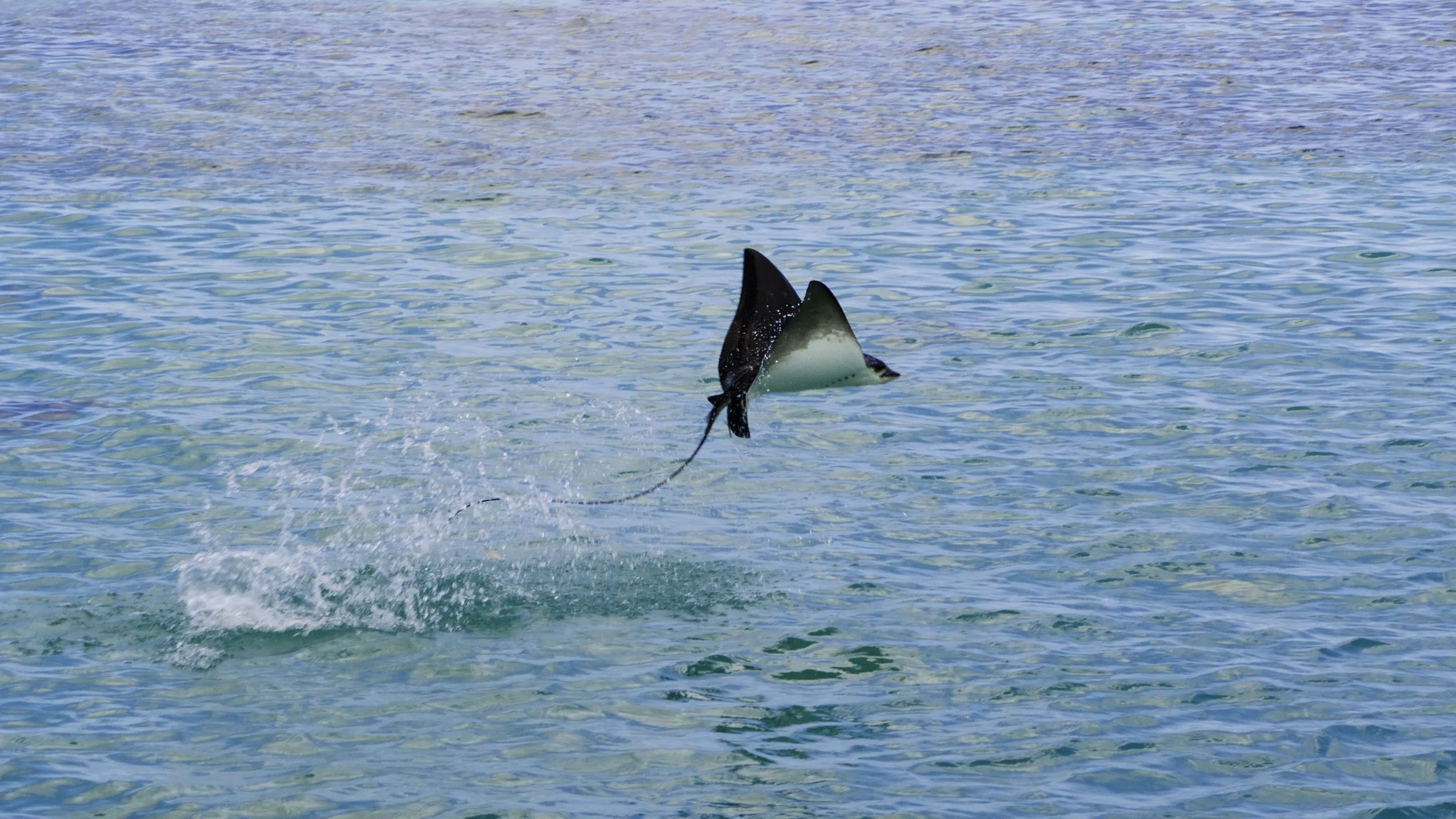
Filming Eagle Rays Breaching in 6K Ultra Slow Motion – Great Barrier Reef
The Filming Method: All sequences were filmed on the RED V-RAPTOR, locked off on a sturdy tripod with telephoto lenses.
Long lenses are essential. They compress distance, isolate the subject against the horizon, and allow space between camera and animal. At those focal lengths, even minor movement becomes exaggerated, so a solid tripod setup is critical.
Everything was shot in 6K at 180 frames per second.
At standard frame rates the breach feels abrupt. At 180fps ultra slow motion, you see the full wing extension, the body flex, the water displacement and the re-entry. It gives natural history productions the ability to study motion properly while retaining broadcast quality resolution.
Manual focus was also key. Autofocus will hunt at long focal lengths, especially over reflective water. Pre focusing on a set distance and making subtle manual adjustments based on surface activity keeps the frame clean and stable when the breach happens.
The RED’s pre record function made a real difference as well. With unpredictable behaviour like this, you often react a fraction late. Pre record buffers several seconds before you hit the trigger, which means you capture the full take off rather than just the tail end.
Those tools matter when the entire event lasts less than a second.
Time and Positioning
Like most wildlife behaviour, this isn’t luck.
It’s repetition and positioning. Long sessions scanning the surface. Reading current lines. Watching where rays are feeding. Adjusting framing constantly to anticipate direction rather than react to it.
You don’t chase breaches. You prepare for them.
When it lines up, it happens fast.