
Behind the Lens on Leon Marchand: Beyond Gold Series
When most people think about Olympic swimming, they picture race day. The crowd. The atmosphere. The medals.
What they do not see are the thousands of hours that happen long before an athlete ever steps onto the blocks.
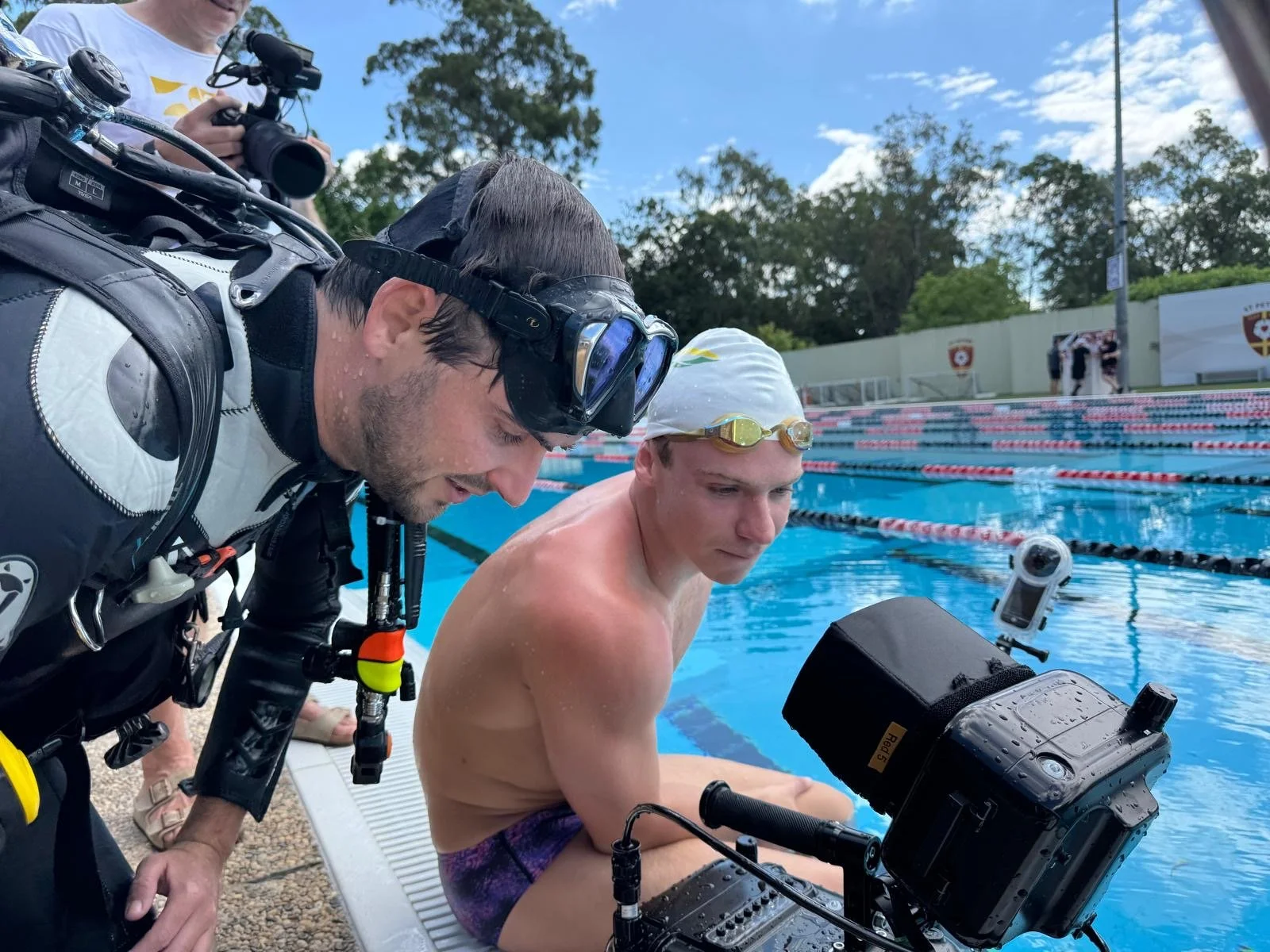
Earlier this year, I joined the production team behind Leon Marchand: Beyond Gold as an underwater cinematographer and topside camera operator, filming Leon's Australian training campaign in the lead up to the World Championships following his extraordinary multi gold medal success at the Paris Olympics.
Produced by Xavier Marchand and Qlad Labs France, and premiering on France.TV, the series follows Leon during a period where much of his life revolved around one thing: training.
As a filmmaker, that meant documenting not just the performances everyone knows him for, but the thousands of repetitions, early mornings, and long days that sit behind them.
Most days began before sunrise. We would arrive at the pool while it was still dark, unloading camera equipment and preparing underwater systems before the first swimmers entered the water. By the time the sun came up, Leon was already deep into another training session, and often it felt like the day had barely started.
A large part of my role involved filming underwater using my RED V-Raptor 8K system. Spending hours submerged in a swimming pool might sound repetitive, but from a camera perspective it is anything but. Every session presented an opportunity to capture the incredible precision that exists beneath the surface. From underwater, you see details that spectators never do. The efficiency of each stroke, the power off the walls, the discipline of repeating the same movements thousands of times in pursuit of fractions of a second. Shooting this in up to 180frames per second in ultra slowmotion, in an effort to showcase the insane microscopic level of perfection on screen.
Many days were spent operating split rigs, allowing us to capture both above and below the waterline simultaneously. These shots became an important visual tool throughout production because they connected two very different worlds. Above the surface you see the athlete everyone recognises. Below it, you see the technical perfection and relentless work that has made him one of the world's best swimmers.
What struck me throughout filming was the sheer volume of training. Session after session in the pool was often followed by hours in the gym, time on the bike, recovery sessions, and preparation for the following day. As cinematographers, we were effectively following that process from the moment it began in darkness until it finished in darkness. The days were long, but they offered a genuine insight into what life looks like when your goal is to remain at the very top of world sport.
The production wasn't confined to the pool either. Part of Leon's story during this chapter was his connection to Australia, particularly around the Sunshine Coast and Brisbane, where he was based for much of the season. These sequences allowed us to step away from the structured training environment and explore a different side of the story. Coming from a natural history background, these were some of my favourite days to film. The coastline, the ocean, and the lifestyle surrounding the region provided a welcome contrast to the intensity of the training schedule and helped show another side of Leon's life outside competition.
What I enjoyed most about working on this project was that, despite being very different from the wildlife productions I usually work on, the filmmaking process felt surprisingly familiar. In natural history filmmaking, success often comes from patience and observation. You spend long periods watching, waiting, and learning behaviour before the moment you're looking for finally happens. Filming elite athletes is not all that different. The challenge is finding those moments that reveal character, determination, and routine, then translating them into images that help tell a larger story.
By the end of the shoot, what stayed with me most wasn't a particular training session or a specific sequence we captured. It was the consistency. Day after day, before sunrise and long after sunset, Leon returned to the same process. The audience will see the results on race day, but being behind the camera offered a different perspective. It showed just how much work sits behind those moments, and why athletes operating at this level are so exceptional.
It’s extremely exciting to see this series air very shortly on France.TV.
For a cinematographer, being trusted to document that journey was a privilege.