
Thoughts on the NIKON ZR in Film Production
Alright, I think Nikon may have accidentally made one of the most useful filmmaking cameras currently available.
After spending a significant amount of time working with the Nikon ZR alongside my RED V-Raptor 8K, I've come to see it as a genuinely valuable tool for professional filmmakers. It isn't designed to replace a dedicated cinema camera, but rather to complement one. What impressed me most was how seamlessly it integrates into an existing production workflow, while still delivering impressive image quality, flexibility, and features in such a compact package.
What's interesting isn't necessarily any single feature. It's how all of the features come together.
Because while there are plenty of cameras that shoot beautiful images, very few cameras fit seamlessly into an existing professional cinema workflow while also remaining small, lightweight, affordable, and practical enough to become an everyday workhorse.
And that's exactly where the Nikon ZR shines.
The Reality of Modern Film Production
One thing that often gets overlooked when people review cameras is how they're actually used on professional productions. Most camera reviews focus on dynamic range charts, autofocus tests, rolling shutter measurements, or lab comparisons. All important things. But in the real world of documentary, wildlife, and natural history filmmaking, a camera's usefulness often comes down to something much simpler.
Working on productions for broadcasters such as the BBC, Netflix, and major natural history projects, there is one thing I can guarantee you.
The wildlife does not care whether you're ready, The light does not wait. The behaviour happens once.
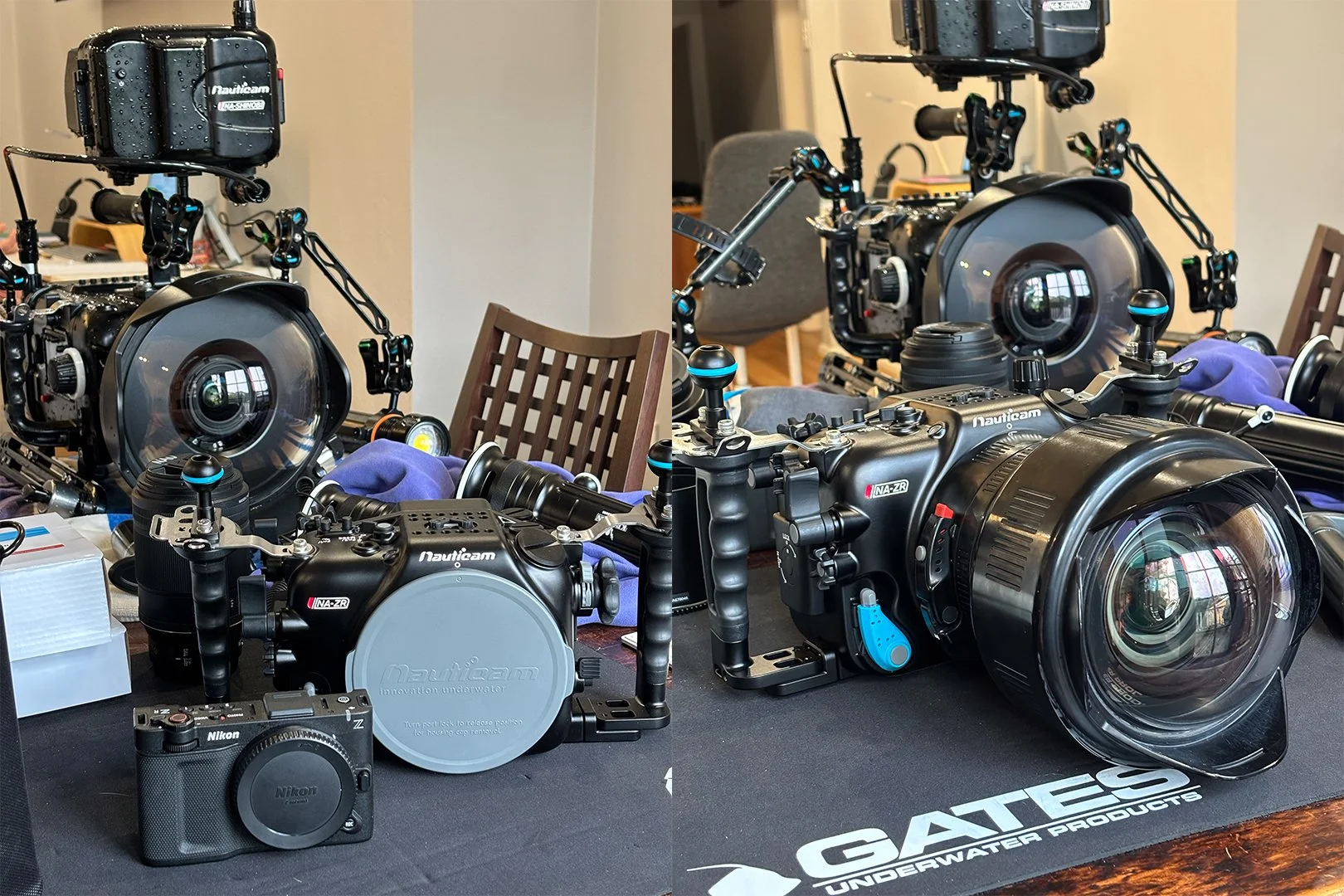
And if you're spending ten minutes swapping lenses or rebuilding a camera rig, you've probably missed the shot. That alongside the increasing need to be able to work multiple cameras, for instance I often find myself shooting underwater with the RED V-Raptor and having a second BCamera built up and ready to shoot topside footage and reactionary content on programs like BBC’s Deadly60. With the fast paced nature of some of these producitons, having multiple cameras rigged and ready to go is such a massive advantage, and keeps production moving.
Often I'll have a RED V-Raptor configured for one task and the Nikon ZR configured for another. Maybe one camera is shooting a wide angle setup while the other is sitting on sticks with a telephoto lens. Maybe one is built for handheld documentary work while the other is configured for locked off long lens wildlife sequences.
The ability to instantly move between cameras without changing lenses, changing settings, or de-rigging and re-rigging is an enormous advantage in fast paced production environments.
And this is where the Nikon ZR fits into my workflow perfectly.
REDCODE RAW Changes Everything
Let's jump into with what is probably the biggest selling point.
REDCODE RAW.
For anyone who has spent years shooting RED cameras, R3D files are an absolute dream to work with. The flexibility in post production is phenomenal. Being able to adjust white balance and ISO after the fact, recover highlights, push exposure, refine colour science with extremely high bit rate files, and generally have complete control over the image long after you've left location.
It's one of the reasons RED cameras have become such a dominant force throughout the wildlife film industry.
As someone who spends a huge amount of time shooting on the RED V-Raptor 8K, being able to pick up the Nikon ZR and continue shooting in REDCODE RAW feels incredibly familiar. The workflow remains consistent, and the footage integrates beautifully. The colour pipeline remains the same, and when you return from a shoot with footage from both cameras, everything simply slots together.
For filmmakers already invested in the RED ecosystem, this alone is a massive advantage.
The Nikon ZR Complements the RED V-Raptor Perfectly
What surprised me most wasn't that the footage looked good. I expected that. What surprised me was just how useful the camera became alongside the V-Raptor.
The reality is that most professional productions benefit enormously from having multiple cameras available. The challenge is that those cameras often introduce entirely different workflows via different codecs, different colour science, different post production requirements, different monitoring setups, and different headaches.
The Nikon ZR solves that problem.
Rather than acting as a compromise camera, it genuinely feels like a natural extension of the RED ecosystem.
One particular area the ZR shines as a complentary camera to the V-Raptor is the dual ISO implementation, which is exceptional.
As much as I love my RED V-Raptor, low light has never been its strongest attribute. Once you start pushing beyond ISO 2000, image quality begins to suffer significantly, and there is a practical limit to how far you can comfortably push the sensor.
The Nikon ZR changes that equation completely. Having a second dual native ISO at 6400 while still recording REDCODE RAW is incredibly useful, and isn’t something RED’s DSMC3 currently has available.
There have already been multiple situations where I've found myself reaching for the ZR over the V-Raptor once the light starts disappearing.
That's not something I ever expected to say.
The fact that a camera this small can outperform a flagship $60,000 cinema camera in real world production situations is remarkable.
More importantly, it makes the camera an incredibly powerful companion to the V-Raptor.
Instead of competing against it, the Nikon fills one of the few areas where the RED system isn't at its strongest.
And that's exactly what you want from a B Camera. The perfect complentary device.
Small Camera. Serious Production Tool.
One thing I really appreciate about the Nikon ZR is how flexible the physical camera body is.
You can strip it down into an incredibly compact package, or you can build it into a fully featured cinema rig.
My current setup includes a Hawklock cage and top handle, baseplate and rail system, Mirage Pro matte box with variable ND, Atomos Shinobi monitor, Mutiny Timecode box, and Bebob V Mount batteries which power both the monitor and provide constant power to the camera.
At that point it feels much closer to a dedicated cinema camera than a traditional mirrorless body. Yet if I need to travel light or throw the camera into an underwater housing, I can strip the entire setup down within minutes.
That flexibility makes a huge difference when working across documentaries, natural history productions, commercials, and underwater projects where every shoot has slightly different requirements.
Professional Audio Without the Fuss
While most of the productions I work on have dedicated sound recordists, and as cinematographers, we're generally focused on the image rather than primary audio capture. Combined with a Mutiny Timecode box for proper sync workflows, it creates a surprisingly capable audio solution when required.
But there are always situations where scratch audio becomes important. Or where a smaller production requires us to capture sound internally.
Having 32 bit float internal recording available is a fantastic safety net. It's not a feature I rely on every day, but when you need it, it's incredibly useful.
The Lens Options Are Exceptional
Another area where the Nikon ZR shines is lens flexibility. The ability to adapt cinema glass onto the Z Mount opens up a huge range of possibilities. If you're already invested in cinema lenses, integrating the camera into your existing kit is straightforward via various existing adapters.
But what has genuinely impressed me are Nikon's newer S line zooms.
The 24-70mm F2.8 S II and 70-200mm F2.8 S II are incredibly impressive lenses. They're exceptionally sharp, the focus throw feels predictable and consistent making manual focus operation feel far more refined than many photography lenses. They're also close to parfocal, and mechanically they feel much more like cinema lenses than traditional stills lenses.
For documentary and wildlife productions where flexibility is critical, they're a fantastic option.
What About Stills?
Like most hybrid cameras, the Nikon ZR also shoots excellent stills.
The quality of these stills are brilliant, but if I'm being completely honest, I find myself relying less and less on dedicated still photography modes.
When you're recording high quality 6K REDCODE RAW footage, pulling still frames becomes incredibly viable.
For many commercial applications, social media campaigns, marketing deliverables, and even some professional stills requirements, frame grabs from the footage are more than capable of getting the job done when recording in 6K and 8K.
Having dedicated stills functionality is absolutely valuable. But the quality of the video files is so high that it almost becomes a secondary feature.
What Would I Change?
To be honest, there isn't much I'd change about the Nikon ZR, and the few things on my wish list are relatively minor software refinements rather than major shortcomings.
Focus peaking during R3D recording would be fantastic to have internally, although this is easily solved by running an external monitor such as the Atomos Shinobi.
I'd also love to see RED's traffic light exposure system make its way across if technically possible, even if only when recording R3D, as it's one of the most intuitive exposure tools available on the RED platform.
Finally, a dedicated toggle between manual and autofocus modes would be a welcome addition. The current hold and aperture dial method works perfectly well, but a faster toggle or tap switch would be useful in documentary and wildlife situations where I often want to quickly grab focus with autofocus before locking the shot off manually.
Image Quality Is King
At the end of the day, none of these features matter if the image isn't good. Fortunately, the image quality is exceptional, and that's really the heart of why I like this camera so much.
The REDCODE RAW files are beautiful, the colour flexibility is fantastic, the dynamic range is impressive. And perhaps most importantly, the footage matches seamlessly with significantly larger cinema cameras. Offering RED RAW recording in a camera this size and at this price point is something that would have sounded ridiculous a few years ago.
For filmmakers starting out, it provides access to a genuinely professional workflow without spending cinema camera money.
For industry professionals, it provides an incredibly capable companion camera that integrates effortlessly into existing productions.
And for someone like me, who spends most of his time bouncing between underwater housings, wildlife rigs, documentary setups, and major natural history productions, that's exactly what makes the Nikon ZR so useful.
It's not trying to replace my RED V-Raptor.
It's making it better.
And honestly, I think that's the highest compliment I can give any B Camera.