
Ultra Wide Angle & Macro in 1 - The Most Versatile Lens in Underwater Cinematography
Anyone who shoots underwater will know just how painful it is when you’ve invested thousands of dollars into underwater camera equipment, and for the first time in months you’ve decided set your rig up to shoot macro. You jump in, and almost immediately you see a train of manta rays swimming overhead, or you encounter your first great white or tiger shark, and there you are unable to capture this once in a lifetime encounter as you decided to shoot macro. It’s a story as old as underwater photography itself, but what if I told you there are solutions available to shoot both wide angle and macro on the same lens.
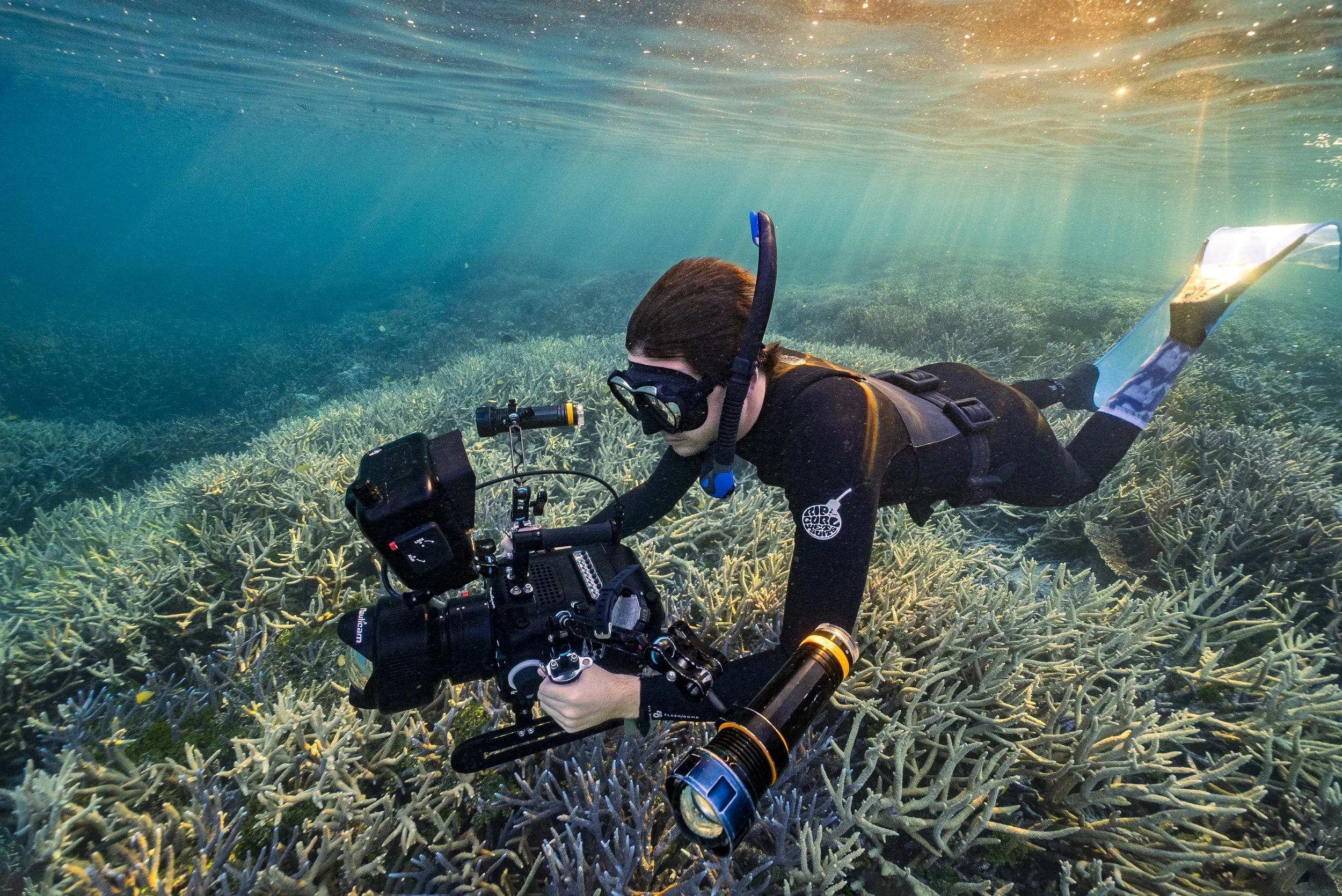
To provide a quick bit of background, I have spoken about this in detail a lot previously, but just quickly, underwater filmmakers and photographers are far more limited in lens choice than topside shooters. Underwater we cannot use medium or telephoto lenses due to the fact that we are shooting through water, with drastically reduced visibility, increased particle, and suffer from loss of light information over vertical and horizontal distances. Underwater anything tighter than approximately 20-24mm usually gives off a very dirty and unclean looking image, with reduced sharpness, contrast, and colour due to the distances we have to shoot from to properly compose our image. Essentially, we have to physically get as close to our subject as possible underwater, and can’t rely on zoom lenses or tighter lenses to close that gap for us. The closer we are, the better quality our shot is as we are removing dirty water from our image. This is why underwater shooters always shoot with ultra wide angle lenses, around 10 – 16mm full frame equivalent, or alternatively to shoot macro.
Thus, we are almost always shooting at extreme ends of the optical spectrum, ultra wide angle, which allows us to capture footage of large subjects like whales, sharks, turtles or reef scapes, or on the other end of the spectrum, macro, which allows us to capture close up footage of some of the oceans tiniest critters. And as we cannot change lenses underwater, and the act of changing lenses and re-waterproofing our cameras is a relatively long task, whichever option we chose before jumping in, we are stuck with for the duration of the shoot.
This leads to frustrating moments when we set up on wide angle where it is extremely hard to capture a range of shots from different focal lengths to cover one scene effectively, such as capturing a wide, medium and tight shot for each scene. But this is even more restrictive when we set our rig up with a macro lens, as are truly limiting our selves to only be able to capture shots of critters no bigger than a few cm long. It happens almost every shoot, where divers set up on macro are unable to capture the breathtaking moments a bucketlist animal appears and banks right in front of their camera.
But what if I told you that we have the optical technology to be able to shoot both wide angle and macro or tight shots using the same lens? And it doesn’t stop there either, this one lens will remove all other major issues with using dome ports by restoring the 3 to 4 stops of corner sharpness that we lose with typical glass domes, and additionally, remove all optical close focus limitations on both the wide end and the tight end, all while maintaining a constant aperture of f1.8.
If someone said this to me a few years ago, I would have laughed at them. What you have described is quite literally the perfect lens, which as we all know is an impossible to task.
But it exists.
The optics I am referring to are the Nauticam Wide Angle Conversion Port, or WACP series optics. Now I just want to say that this is not a sponsored article, and I bought my WACP at full retail price. It’s an expensive, but revolutionary piece of kit that does exactly this. Make no mistake, this is not just a window for my camera to shoot through, it’s a highly advanced optical tool.
Behind this conversion port, can sit a range of standard zoom lenses, such as the Sigma 18-35 f1.8, the Canon 28 – 80, and a variety of other lenses from Sony, Canon and Nikon. These lenses by themselves are nothing crazy, and they certainty would not be appropriate underwater lenses in their own right. I personally use the Sigma 18-35 f1.8 behind mine majority of the time, and this conversion port will convert that 18 – 35mm image to a full frame equivalent focal range of 11mm on the wide end, to just over 50mm on the tight end. This can be shifted slightly tighter with different lenses like the Canon 28-80.
This optical conversion is mind-blowingly done in a way that heightens the lens sharpness, and renders the image with 3 to 4 stops sharper corners than standard dome ports. It also overhauls the lens and allows it to focus right on the dome port, with a close focus distance of 0, at both 11mm wide, and at 50mm on the tight end, which is insane considering that almost all other wide angle lenses have a close focus distance of around 20 to 30cm.
In simple terms, this conversion port allows both ultra close focus wide angle shots, and macro shooting to be undertaken on one lens system, and renders those images with extreme sharpness in both the centre and the corners. And there’s no iris or aperture limitations as this is all regulated by the lens behind the conversion port, which in my case grants a constant aperture of f1.8.
It's truly a revolutionary piece of equipment, that I can honestly say has drastically enhanced my cinematography, not only allowing me to capture a variety of different shots for each scene, much the same way I would while shooting topside to build out a sequence, but it allows me to be prepared for any eventuality.