
Why I Love Underwater Cinematography
In the world of wildlife filmmaking there’s really nothing that compares to underwater cinematography. Wildlife filmmaking is dominated by telephoto lenses with most cinematographers relying on the Canon 50-1000mm lens, a technological feat that allows cinematographers to capture wildlife footage from the safety of a few hundred meters away.
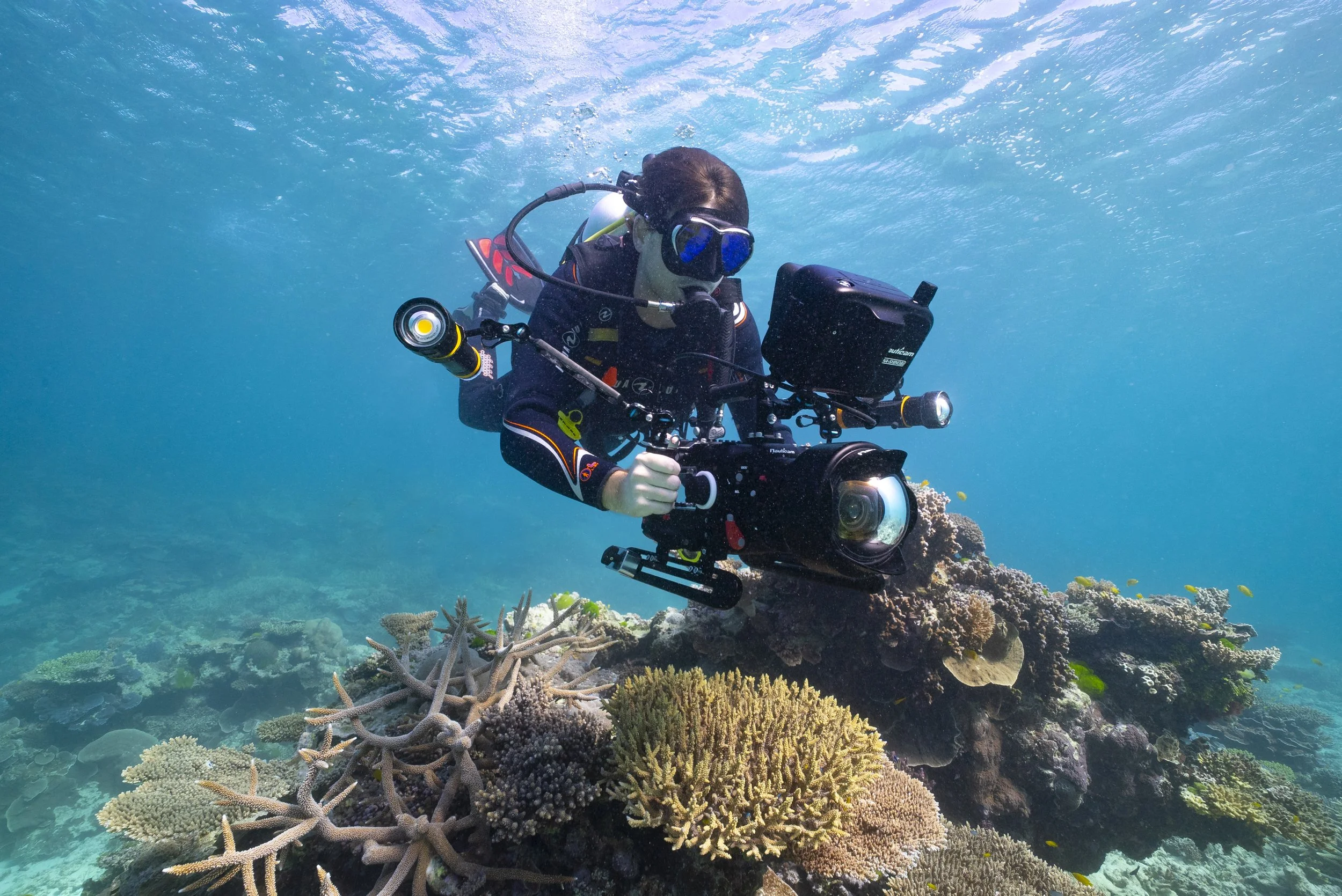
For underwater shooters, this is like a cheat code. Underwater, we often can’t capture good quality footage if we’re any more than 3 or 4 meters away. Putting this in perspective, if we were on a documentary and were looking to film lions hunting, we would have to be standing right next to them as they prowled through the jungle looking for food, not from the safety of a car 200 meters away. We have to not only be in the action, we often find ourselves as part of it. And this is what makes underwater cinematography so epic.
I can almost guarantee that if you have seen any wildlife documentary shot above the water in the last 10 years, that a good portion of that film would have been shot on the Canon 50-1000mm lens. This 70,000 dollar lens is a staple in wildlife filmmaking due to it’s compact size, optical performance and importantly it’s zoom range, allowing cinematographers to capture breathtaking content while being completely removed from the action. The way in which these films are shot is often with the film crew positioning themselves at good vantage points around the location, utilising tripods to snipe the action when it occurs. The lens has the ability to both capture close encounters, although rare at 50mm and encounters hundreds of meters away at 1000mm.
Underwater films however differ dramatically in the way in which they’re shot. Due to visibility, and the way in which water and particles impair our footage, cinematographers have to use ultra wide angle lenses, with most focal lengths ranging from 11 to 18mm. We don’t have the luxury of using zoom lenses to get close to our subjects, as the image quality will be unusably blurry, and we often simply can’t see past 15 -20 meters away. Which in other words means that we cant zoom in to get close up footage of wildlife, and the only way that we can get those intimate shots is to physically swim closer to the animal. Underwater, if we’re any more than 2 or 3 meters away from the animal, it’s probably not a great shot, and we’re often required to get much closer than that.
This creates some really unique challenges, as not only are we looking to capture natural wildlife behaviour, but we’re also hoping to be centimetres away from the animal when they exhibit it. Instead of simply finding a vantage point and zooming in like on land, we have to manage a proper approach towards the animal, conducting it in a manner that doesn’t spook them, and literally position our camera right next to them to capture the shot. This is understandably quite tricky to pull off, but it also places us right in the heat of the action, which at times can be far more dangerous and require far more knowledge of wildlife behaviour.
Especially when we’re filming larger animals like sharks and bait balls, which are like ocean feeding frenzies dominated by apex predators, where when filming this sort of interaction, we find ourselves literally in the centre of a feeding frenzy, using our large cameras as a shield from predators. Events like these really get the adrenaline pumping, as you very much become part of the action, and you’re not only focused on capturing the shot, you’re focused on managing predatorial behaviour and keeping yourself safe.
This crazy feeling of being in amongst the action, filming it all on an ultra wide angle lens, is what makes underwater cinematography so unique. We have to master underwater wildlife behaviour, and use our knowledge of the animal to manage our interaction with them to ensure that we not only capture the shot, but do so safely and without disturbing or harassing the wildlife.
Recently while on a documentary shoot capturing the Sea Turtle mating season, I found myself the target of a sexually fuelled large male sea turtle. Now I want you to forget everything you know about sea turtles, as when these turtles reach mating age they can be as big as 5 feet long and upwards of 400 to 500 pounds. They have massive claws on the front of their fins, and they have unbelievably powerful jaws that they use while mating to hold the female down. They are quite literally dinosaurs.
While filming this mating interaction between 2 sea turtles, only a few meters away from them, 2 additional males arrived at the scene and began fighting with the successful suitor. After a few minutes one of the unsuccessful males gave up and turned his attention to me.
The standard approach for any underwater cinematographer caught up in a moment where they became part of the action, is to use their camera as a shield. And that’s what I did for the first few minutes as this mammoth of a male took a number of fast and power strafes towards me, pulling away only at the last second as I deflected with my camera. But as this continued and I didn’t want him to damage or scratch my glass dome, I moved to a different tactic, and tried to use my freediving fins to provide a barrier between us and keep us apart, all while slowly swimming to shore where I could. All I have to say is that that did not work, and I very much underestimated the strength and speed of these animals.
He didn’t get his way with me, and I eventually made it back to shore, but I would be lying if I said I wasn’t a little nervous as to how that interaction was going to end. Underwater cinematography can give rise to the unexpected as we are never more than 10m away. It’s not uncommon to become part of the action, whether that be with a thirsty sea turtle, or a school of fish who ball up around you for protection from some larger fish species, sometimes the unexpected happens. And more than ever underwater cinematography requires an understanding of wildlife, and an appreciation that we are in their world.
It's like trying to film an African safari with a 14mm lens, where You have to walk right up to the lion to get the shot. It’s requires such a high level of behavioural understanding to do this, it’s probably crazy and it’s definitely unique. And that’s why I love it.