
The power RED RAW in underwater cinematography
If you’re an underwater filmmaker or photographer, you will know just how hard getting perfect colours is underwater. Particularly from a videography perspective, where pulling accurate and life like colours from an underwater scene is post production is often very difficult, even impossible at times.
If you’re not an underwater videographer what we are talking about is that green wash you see with beginner underwater footage, a common example is the hideously green underwater GoPro footage that you’ve no doubt come across at one point or another.
Explaining this in the simplest of terms, without diving into the physics behind wavelengths, and comparing the wavelengths of the visible colour spectrum to things like gamma & X rays, light has a very hard time passing through water, with red, orange and yellow tones not being able to penetrate even the shallowest water. Once we get to approximately 10 meters deep, the only light that is able to penetrate the water column is green and blue, making all your footage look like you’re shooting through green cellophane wrap. This light or wavelength principle applies both vertically and horizontally to make things even harder.
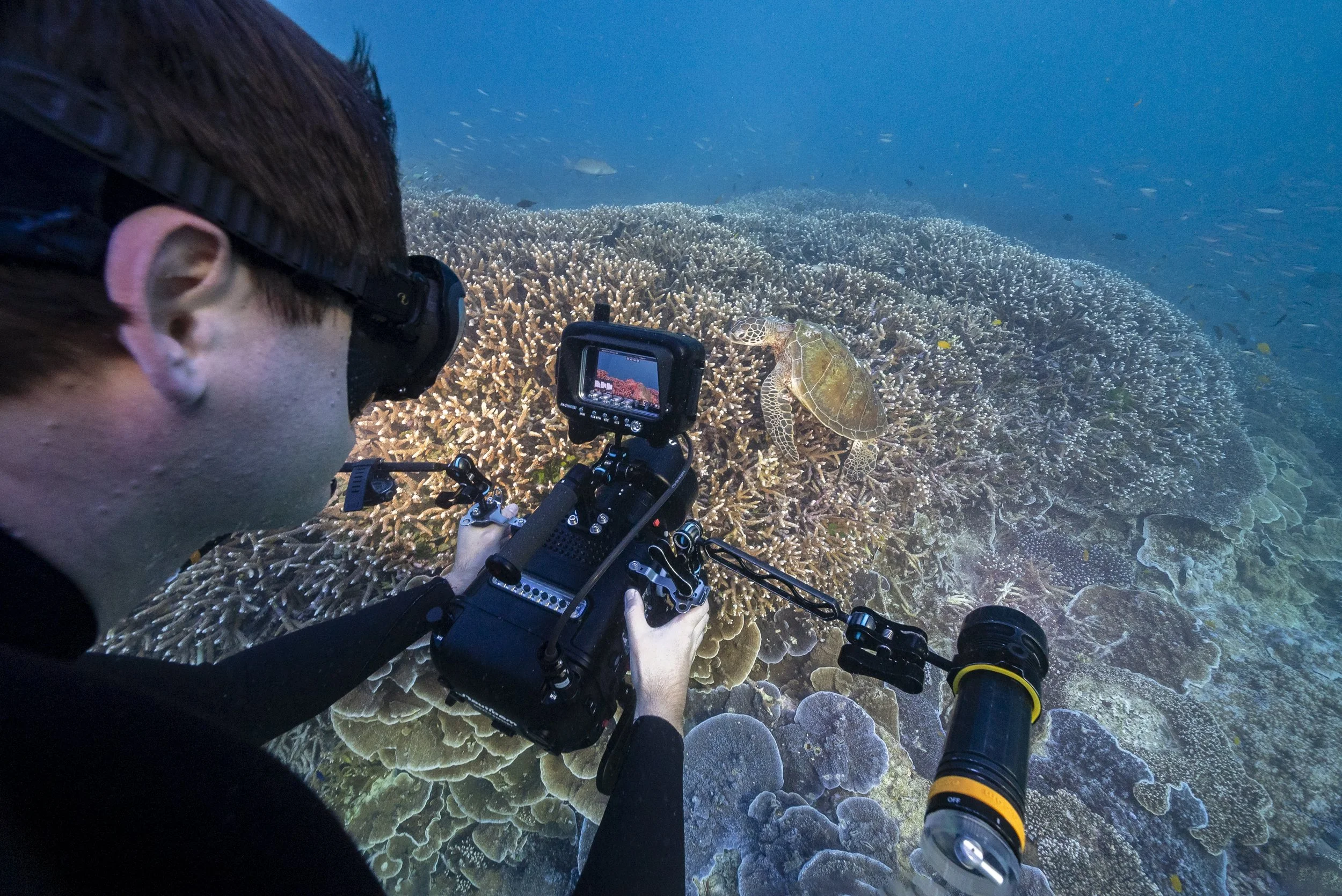
Essentially, this means that underwater we have to very meticulously dial in our colours every minute or two while shooting depending on both the depth we’re filming at, and the distance of our subject, all while accounting for things like how far the beam of our artificial lights travel, and the kelvin of our artificial lights. Even for the most experienced underwater shooters, this is often something that is quite tricky to perfect.
But imagine a world where we can capture perfect colours every single time, with absolutely no effort at all. A world where the water is always blue and our subject is always colour accurate. This is the power of R3D RAW files.
As an underwater specialist, for me colour is everything. Nailing colour underwater every single time is a very difficult thing, and it requires a near constant tinkering to nail. Personally, nailing underwater colour is one of the things I really pride myself on, and It’s one of the leading reasons that my clients keep coming back to me, because with a good understanding of underwater colour and meticulous colour management even the worst underwater scenes can look decent.
This is where RED Digital Cinema’s R3D RAW format comes into play, and truly revolutionises underwater colour and white balance management, offering perfect colours every single time. R3D RAW files are like a digital canvas that retain every colour nuance and detail of your underwater scene. Using REDs IPP2 Image processing pipeline and it’s Wide Colour Gamut it allows every colour the cameras sensor can generate to be manipulated in post production without clipping
Essentially, the colours can be manipulated to perfection in post production such that you can simply set the colours perfectly every time in your edit, with no drawbacks. It operates a little differently to RAW photographs, but the base principle is the same, and for underwater video shooters it’s truly a game changer.
But RED RAW files don’t just exceed in their ability to manipulate colour perfectly, they also capture an incredible amount more colour detail than most other cameras.
Only 2 or 3 years ago mirrorless DSLR’s maxed out with 8bit colour depth, where these cameras would record 16.7 million colours. It sounds like a lot, but in reality when compared to how good the human eye is, it’s not, and we would often see banding across the screen in 8 bit shots, particularly in scenes where there is a strong gradient in light, or excessive editing had occurred. The 16bit RED RAW files on the other hand capture an unbelievable 281 trillion colours, nearly 17 million times more colours than 8bit cameras, and 1.5 million times as many colours the 10bit files of most of today’s leading mirrorless cameras.
In practice, this extreme level of colour perfection preserves the vibrancy and subtlety of underwater hues, and showcases the oceans rich blues and intricate shades to a level that I had never before thought possible. There’s a reason BBC and Nat Geo always have picture perfect underwater visuals, and that’s because of RED RAW.
It’s better than real life. It’s always perfect, even when the ocean is far from it. And as an underwater cinematographer this level of colour accuracy and depth is truly what dreams are made of. I feel like I should probably mention it, but 6K and 8K recording is also pretty nice.
Even with the power RED RAW at my fingertips though I still do meticulously set my colour in camera, but the added flexibility of guaranteed perfection is why these cameras are a requirement for higher end productions and documentaries. Anyways that’s it for this one. I hope you had a great read, and I’ll catch you in the next one.